
The Invisible Weight of Autism Caregiving
About four or five years ago, I was on the phone with Krishna’s psychiatrist. I remember I was walking around the garden while I spoke to her because the house was too noisy to have the conversation inside. We were talking about Krishna, of course. I don’t remember exactly what we were discussing that day—behaviour, medication, sleep, some difficulty we were trying to understand. There was always something. And somewhere in the middle of that conversation, she asked me, “But how are YOU doing?”
I cried.
I hadn’t even known those tears were backed up. She hadn’t offered me a magic formula. She didn’t have a magic pill for Krishna, and she certainly didn’t have one for me. Nothing changed as a result of that conversation. When I hung up, I still had the same child, the same responsibilities, the same noisy house waiting for me. There was no new caregiver waiting at the door, no extra three hours added to my day, no solution to whatever problem we had been discussing. But another human being, someone who knew enough about the challenges to understand what she was looking at, had turned her attention away from Krishna for a moment and looked at me. She had perceived that I was carrying a lot, and she had taken the time to acknowledge it.
There is a particular loneliness in autism caregiving that has little to do with whether there are people around us. It is the loneliness of having the weight of what we carry remain unseen.
We don’t always need someone to fix things. There may be no fixing to be done. We don’t necessarily need advice, and God knows autism parents are rarely suffering from a shortage of advice. We need another person to look at the reality we are living and say, in whatever words come naturally to them, I see that this is hard. I see how much you are carrying. How are you doing?
Oddly, I say this despite having a very supportive inner circle. I don’t even count my husband when I think about this, not because his support doesn’t matter—it matters enormously—but because he is in the situation with me one hundred percent. He is almost an extension of me in this context; we are a unit. There are things I don’t have to translate for him because he already knows. He isn’t standing outside the load, looking at it and acknowledging that it is heavy. He has his shoulder underneath the same load.
And yet even in a loving, supportive family, there are moments when the difference between living inside a reality and looking at it from outside becomes startlingly clear.
The Things That Cost More Than They Look
Someone might ask me to just leave Krishna for a second and come answer a question. It really is only a second. The question may take almost no time. To the person asking, this is an entirely reasonable request.
Except a second is all it takes.
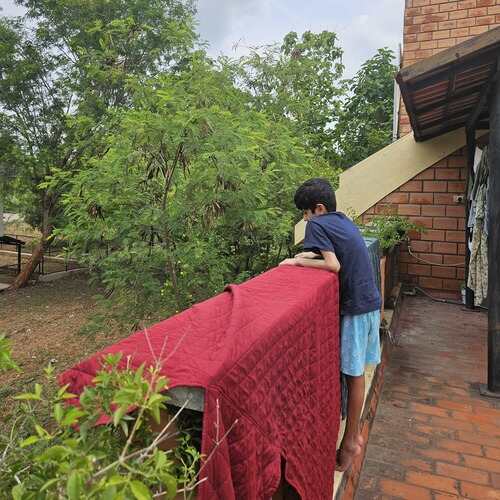
Krishna can dash onto the terrace, throw one leg onto the parapet wall and stand there, ecstatic about the semi-balanced sensation while also apparently appreciating the view. Yes, proprioceptive OT is happening. Meanwhile I come dashing back, see him on the parapet and almost have a heart attack, whereupon he looks at me, giggles and rushes away because he knows perfectly well that this was an illegal activity. The rule he understands. The danger he does not.
So “but it was just a second” doesn’t really hold water in our house.
Then comes the perfectly sensible next question. Why don’t you secure him somewhere first? Why don’t you bring him downstairs and then come back?
Because bringing him downstairs isn’t a thirty-second operation either. At that moment Krishna may be perfectly happy, active and wanting to play exactly where he is. Moving him means interrupting what he is doing, getting his attention, persuading him to transition, explaining why, perhaps bribing him, accompanying him down and settling him into something else. What looks from outside like a trivial action can easily become ten minutes of strenuous effort.
On another day I might do it. But today I may not have those ten minutes of energy to spare.
We tend to calculate the cost of caregiving tasks in minutes, but minutes are often a terrible measure of cost. Ten minutes spent drinking tea is not the same ten minutes as persuading a resistant child through a transition. Ten minutes filling a form is not the same as ten minutes preventing a meltdown. There is physical energy, cognitive energy, emotional energy, vigilance, negotiation, interruption and recovery. And when energy is finite, every unnecessary expenditure has an opportunity cost. If I spend it here, I may not have it for something essential that I cannot avoid later.
The person outside sees the visible task. The caregiver pays the full price.
And then, strangely, we often have to pay another price on top of that: we have to explain why the first price exists.
Why can’t you just leave him? Why can’t you bring him down? Why can’t you make him understand? Why can’t you come for an hour? Why can’t you just say no?
The word just can carry an astonishing amount of invisible labour.
I don’t always want to explain. Not because I am angry with the person asking, and not because they are necessarily doing anything wrong. I simply don’t want to spend the energy explaining the transition, the risk, the sensory need, the behaviour, the consequence, the ten minutes after the ten seconds, because that explanation itself is an expenditure of energy I would rather use on an essential task I cannot avoid.
This is in a supportive family.
What, then, is the experience of a parent whose family is actively unsupportive?
When Support Becomes Indulgence
I know stories of mothers who have walked away from marriages and families because they eventually decided that being a single mother to their child was the life they were willing to choose, because the child deserved someone who would stand beside them. I know women who remain inside families where the struggle continues every day. Fathers can occupy this position too, although the stories I encounter most often are of mothers. And in some families the mother carries another ancient and ugly burden besides: the suggestion that somehow she produced the “faulty” offspring, and then compounds her offence by derelicting her other duties because she is spending too much time caring for the said offspring.
When every decision about your child becomes another argument inside your own home, home itself stops being the place where you can put the fight down.
But there is another experience that may be even more common, precisely because it is harder to point to. The family isn’t actively cruel. They aren’t stopping the mother. They may even help. They simply indulge her strange obsession with this child.
The child is autistic, after all. He is fed on time. He is dressed. He seems perfectly happy. What exactly is she trying so hard to achieve?
So they indulge her insistence on routines, therapies, communication, food, sensory needs, teaching, outings, opportunities, whatever it is she believes matters. You know how she is about him. Nobody has to say anything openly hostile. The message can arrive sideways, in little remarks, sighs, expressions, the faintly amused tolerance we extend to someone else’s harmless eccentricity.
And I think indulge is the right word, because indulgence can look superficially like support while withholding something much more important: respect.
The disagreement underneath may not really be about therapy or schedules or how much time the mother spends with the child. It may be about something far more fundamental. What does this child experience? What does he understand? What might he be capable of? Does he have preferences we have not yet learned how to read? Might there be pain behind behaviour, intelligence behind silence, or simply more of a person here than we presently know how to see?
For me, this comes down to personhood.
I do not know everything Krishna is capable of. I don’t know his limits either. There are things I once hoped for that I now see differently, and things he has done that I would not have predicted. I have been wrong before. I will be wrong again. But I want to remain curious about the person in front of me rather than deciding in advance what kind of life is enough for him simply because he is autistic.
Being Heard Is Not the Same as Being Agreed With
There is an important caution here, because the mother who has become consumed by the fight for her child isn’t necessarily right. Love does not make us infallible. Sacrifice doesn’t prove that an intervention is useful. Fear can make parents pursue too much. Hope can make us vulnerable. We can become so frightened of missing the one thing that might help that childhood itself becomes an endless improvement project. A child should not have to spend every waking hour being worked upon in order to justify our hope for them.
But the supposedly obsessive overachiever mother isn’t necessarily wrong either.
She may be seeing something.
Being heard does not mean being agreed with. Being seen does not require everyone around us to defer to our judgement. The humane response can be something much simpler and, I think, much more useful.
What is it that you are seeing? I’d like to see it too.
There is so much room inside that question. It respects the parent’s knowledge without declaring the parent omniscient. It leaves room for another person to say, I see something differently. Can we look at it together? Most importantly, it treats the child as a person worth being curious about.
And I think that kind of acknowledgement does something else too. Being seen doesn’t merely make us feel better. It can help us think better.
If I have to defend every decision I make for my child, eventually I may become very good at defending. If every conversation begins from the assumption that I am doing too much, expecting too much, worrying too much, spending too much, imagining too much, then I arrive at the conversation already braced for opposition. I am no longer examining one decision. I am defending the entire premise that my effort is necessary, that my child is worth the effort, perhaps even that I have the right to trust what I know about my own child.
And when we spend enough time defending a position, it becomes harder to step out of it.
I may be doing too much this time. This therapy may not be helping. This particular battle may not be worth fighting. Krishna may be telling me something I have been too anxious to hear. But it is much easier to ask myself those questions when the person beside me begins with, I understand why you are doing this. Tell me what you’re seeing.
When I don’t have to fight for the right to act, I have more room to question the action.
There is an unnecessary burden in being pushed repeatedly into the position of the lone crusader. A parent who repeatedly learns that nobody else will fight for the child can begin to feel that she cannot stop fighting, because stopping feels dangerously close to abandoning the child. And the more defensive she becomes, the more those around her may see her as obsessive, which makes her defend herself still more.
What a waste of energy, on all sides.
And there are parents who genuinely cannot step away from the situation. Financial dependence is real. Housing is real. The practical impossibility of caring for a high-needs child alone is real. The absence of alternative caregivers is real. “Set boundaries” sounds wonderful until the consequences of setting them threaten the support on which you and your child depend. “Leave” is meaningless when you cannot afford to leave. “Ask someone else for help” assumes the existence of someone else. “Do less” is useful advice only if there is something on the list that can safely remain undone.
There are lives in which every route really does feel closed.
The Mountains Nobody Else Can See
And then there is another kind of loneliness, one that can exist even without conflict. It is the loneliness of having nobody who understands why the small things aren’t small.
I think of it as the lame mountaineer.
If an able-bodied mountaineer walks a kilometre and a lame mountaineer walks the same kilometre, the distance tells us almost nothing about the achievement. We need to know something about the legs that travelled it. A hill that barely registers to one person can be Everest to another.
Autism families live with this distortion of scale all the time.
A child tolerates a haircut. Eats a new food. Sleeps for four uninterrupted hours. Goes somewhere unfamiliar without distress. Uses a toilet. Waits. Tells you that something hurts. Makes a joke. Manages a transition that six months ago seemed impossible. Communicates something clearly for the first time. Does some ordinary little thing that millions of families would barely notice.
And you want to turn to someone and say, Did you SEE that?
Because you know the mountain.
You know the months or years behind that tiny visible step. You know what it cost the child. You know what it took to get here. Other people may be pleased for you, of course, but their “Oh, that’s nice” can remind you that they cannot possibly know why you feel like yelling about it from the rooftops.
We spend so much of our lives cheering our children on. We notice effort that other people don’t notice. We know when something was difficult even if they made it look easy. We celebrate another attempt. We encourage them after failure. We learn their mountains well enough to understand that a tiny movement can represent an enormous climb.
I wonder who does that for the parent.
Not the grand declarations about autism warriors and supermoms. I have never particularly wanted a cape. The problem with turning people into heroes is that heroes are apparently expected to keep carrying impossible things without getting tired.
Something smaller would do.
I saw how hard that was. I know that wasn’t a small thing for you. You must be exhausted. How are YOU doing?
Sometimes Acknowledgement Is the Help
This is why being unseen takes such a toll. There is the caregiving load itself, the hidden cost around apparently simple tasks, and then the explanatory load of continually having to establish why those costs are real. In some families there is another layer still: defending the very legitimacy of the effort, and sometimes the personhood of the child for whom the effort is being made.
That requires an extraordinary amount of energy, courage, inner strength and physical and mental stamina. Of course it takes a toll. Of course emotional harmony sometimes disappears. Anger, irritability, tears, withdrawal and despair can become more common than we would like them to be. Before we decide that a parent needs to become better at regulating, it is worth asking what is being demanded of the system we are asking them to regulate.
Sometimes the nervous system is reporting reality.
This doesn’t mean we abandon responsibility for how we behave. Our children should not have to absorb our exhaustion simply because the exhaustion is understandable. We still have to notice when we are becoming the person we don’t want to be, repair when we get things wrong, seek help where help exists, change what can be changed and learn ways of carrying what cannot. But compassion and accountability do not have to cancel each other out. Knowing why I am struggling can be precisely what gives me enough room to respond differently.
And being seen can create some of that room.
It does not reduce the number of appointments. It does not make Krishna safe on the parapet. It does not manufacture money or respite or sleep. It doesn’t fix a marriage or transform an unsympathetic family. Acknowledgement isn’t a substitute for practical support, and we shouldn’t pretend that a kind question can compensate for years of carrying an impossible load alone.
But acknowledgement changes something about the experience of carrying.
Help can change the load. Acknowledgement can change the experience of the load. Curiosity can change the relationship around it.
Sometimes only one of those is available.
Four or five years ago, Krishna’s psychiatrist could not help me carry the practical load. She was somewhere at the other end of a phone while I walked around my garden because my own house was too noisy to have the conversation. She couldn’t change whatever we were dealing with that day. I don’t remember whether we solved anything at all.
But I remember her question.
But how are YOU doing?
Perhaps she doesn’t remember asking it.
I do.
For a few minutes, I didn’t have to explain why I was tired. I didn’t have to prove that something was difficult. I didn’t have to defend how much I was doing or wonder whether I was doing too much. Someone who knew the terrain had looked at the mountain, looked at me, and understood that I had been climbing too.
Then, presumably, I wiped my face, finished the call and went back into the noisy house.