
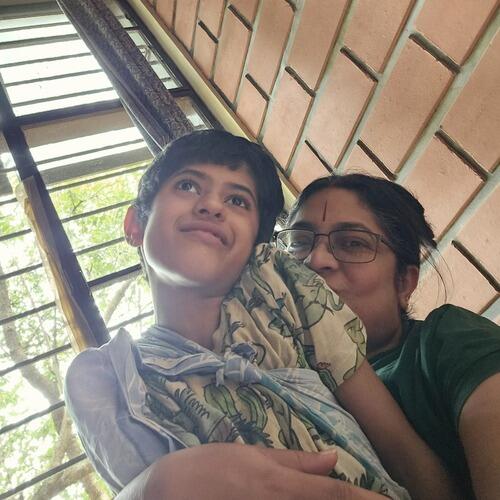
The doctors are holding Krishna’s hand down so they can inject him with anaesthesia.
“Vendama!”
I don’t want it.
He fights ferociously, but at the prick of the needle, his little form sags into my arms, deep in sleep.
And then they take him from me and carry him into the operation theatre.
That was the first time my husband and I broke down together.
Neither of us had the strength to hold the other up. We were together, but alone in ourselves, each silently shrieking at ourselves for having betrayed this little boy to a decision he had fought with all his little strength.
Krishna was four and a half years old.
He had bilateral inguinal hernia. His doctors had advised us against waiting for an emergency. The difficulty was that nobody could tell us when—or even whether—that emergency would happen.
He might need surgery the next instant.
Or he might be fine for the next twenty years.
But if the hernia became strangulated and he needed surgery immediately, we might not even recognise what was happening quickly enough, let alone be able to access the specialised medical care he would need.
So we decided on planned surgery.
Krishna had other ideas.
They began trying to sedate him at around five in the morning. Four hours later, the child was still fighting it.
He was teetering on the stool like a tiny drunk, but those brilliant black eyes were glittering with determination.
He. Was. Not. Giving. Up.
Eventually the medical team told us they couldn’t wait any longer. The operation theatre was booked for another surgery later that day. They would have to anaesthetise him.
And so the nurses, the doctors, and my husband and I all held our son while they put a needle into him against his will.
“Vendama!”
Then his body went limp in my arms.
And they took him away.
The surgery itself went beautifully.
After sleeping off the anaesthesia, Krishna woke up, saw me and leaped straight from the recovery bed into my arms. He yanked out the hated cannula; he didn’t care for the pain. He still cared, very much, that it had been fixed against his will. Blood geysered upwards, painting the horrified nurse and her station crimson.
Krishna did not cry. He settled into my arms after that, indifferent to our fussing over his bleeding hand.
We took him home that afternoon. It was a day procedure.
His hernias healed very well.
And Krishna never spoke again.
Eight years later, my husband and I still sometimes return to that day.
Did we force a decision on Krishna that he was somehow intuitively rejecting? Should we have waited until he was older and better able to understand what was happening? Did the surgery or anaesthesia somehow trigger his loss of speech?
We don’t know.
I want to be very precise about that because the sequence of events is all I can truthfully give you. Krishna spoke before the surgery. He underwent surgery under general anaesthesia. His speech disappeared.
The temporal association is devastating to us as his parents.
It is not proof of causation.
And despite everything that followed, I still believe we made the right decision.
That distinction matters, because this isn’t a story about discovering, years later, that we made a terrible mistake. We knew Krishna had bilateral inguinal hernia. We knew there was a risk of an emergency. We knew we might not recognise that emergency quickly enough. We spoke to his doctors. We weighed the risks of surgery against the risks of waiting. We made an informed decision with the information available to us.
The decision achieved the outcome for which we made it.
His hernias healed.
And something devastating that we did not expect followed.
Both things are true.
Krishna’s surgery was an unusually consequential decision, but the structure of it is not unusual at all. As autism parents, we make versions of this decision over and over again: with incomplete information, competing risks, no guaranteed outcome, and somebody we love living with whatever follows. Some decisions are enormous. Others look almost trivial from the outside. But when enough of them accumulate over enough years, the phrase “decision fatigue” begins to feel rather inadequate for the load we are actually carrying.
Which therapist? Should you investigate this? Is this pain or behaviour, sensory distress or anxiety, communication or something else entirely? Doctor? School? Medication? Therapy? Stop therapy? Push? Wait? Insist? Back off? Change schools? Try this treatment? Stop this treatment? How long do you wait before deciding whether something is working?
Sometimes your child cannot tell you clearly what they are experiencing. Professionals disagree. Evidence may be incomplete. Another autistic child’s experience may tell you something useful and still tell you very little about yours. The theoretically best option may not be available, affordable or tolerable. You may not know for months whether something helped, and sometimes you may never know exactly why things changed.
Even doing nothing can itself be a decision.
But the exhaustion runs deeper than the sheer number of decisions. Underneath it is something closer to: “I am tired of carrying the possibility that every decision I make could hurt the person I am trying to protect.”
These are not neutral choices. You may be deciding about another human being’s body, education, communication, health, comfort, future, independence and quality of life. And when the decision is yours to make, the responsibility is real.
You have a responsibility to make it as thoughtfully as you reasonably can. You gather information, ask questions and look at evidence. You listen to professionals without assuming that confidence is the same thing as certainty. You observe your child. You consider risks and possible benefits, but also what the intervention asks of your child and what it asks of everybody else in the family. Eventually, with whatever information you have been able to gather, you decide.
The decision is yours to make; the outcome isn’t yours to control.
That does not mean your actions make no difference to outcomes. If that were true, there would be very little point in making decisions at all. You act precisely because what you do can change probabilities. You don’t control the outcome, but you do your damnedest to give the outcome you want the best reasonable chance of happening.
Suppose your child struggles to sit comfortably in class or sustain attention, and you want to help them participate more easily at school. You ask questions. Teachers or professionals may suggest occupational therapy. You investigate what you can and decide that OT seems like a reasonable way of moving towards the outcome you want.
That decision matters. But taking your child to occupational therapy does not place you in control of what happens next.
Perhaps their sitting tolerance improves. Perhaps it doesn’t. Perhaps something changes in the therapy room but never transfers to the classroom. Perhaps there is another factor in the classroom nobody noticed, or the original problem isn’t quite what everyone thought it was. Perhaps the therapy centre itself creates a difficulty you never foresaw. Perhaps the therapy helps one thing while making another part of life harder.
Your choice has influence. It does not give you control.
And this distinction matters because “we cannot control outcomes” can slide very easily into another thought, especially after you have been carrying all of this for years: “Then what difference does anything make? Why research all this? Why keep trying? Why not just do whatever is easiest now? Why not wait for things to happen?”
Sometimes doing nothing genuinely is the wisest decision. Sometimes waiting is exactly what reality requires. But consciously deciding not to act is very different from becoming so worn down by uncertainty that action itself begins to feel pointless.
Lack of control is not lack of influence.
You cannot command the future. You can still work to improve the odds.
Responsibility and accountability have to be separated from control. You are responsible for making the decision as thoughtfully as you reasonably can. You cannot determine what follows simply because the decision was yours. But when the outcome arrives—wanted, unwanted, mixed, or simply confusing—you are accountable for paying attention to it.
If you chose OT because you hoped it would help your child participate more comfortably in class and three months later nothing seems to have changed, the outcome gives you new information. Is the difficulty unchanged everywhere or only at school? Was the original difficulty what everyone thought it was? Is the therapy addressing the thing you hoped it would address? Is something else happening in the classroom? Is the centre itself creating stress? Is your child gaining something that your original measure failed to capture? Do you continue, modify, investigate further or stop?
Accountability asks questions of the outcome.
It doesn’t mean you caused everything that happened. It means that because you made the decision, you don’t turn away from what followed. You don’t hide behind “I did my best” and refuse to look. You also don’t look at an undesired outcome and immediately turn it into proof of your failure. You ask what reality is telling you now that you did not know before, and you take that information into the next decision.
Sometimes that examination will tell you something uncomfortable. Sometimes you really did get it wrong.
“I did my best” cannot become a blanket absolution from examining ourselves. We can overlook something we reasonably could have noticed. Desperation can make somebody else’s certainty particularly attractive. Fear can distort judgement. Fashion, anecdotes, authority or wishful thinking can carry more weight than they deserve. Sometimes we continue something because we have invested so much hope, money or effort in it that stopping feels unbearable, even when the evidence in front of us is telling us to reconsider.
Accountability has to leave room for the sentence: “I got that wrong.”
And then for the more useful questions that follow it: “What did I know at the time? What could I reasonably have known? What did I miss? What did I give too much weight to? What has this taught me? What would I do differently now?”
The same discipline applies when things go beautifully.
If your child begins participating more comfortably in class after starting OT, that matters. The therapy may have contributed significantly. You should notice what worked and learn from it. But a wanted outcome does not suddenly give you powers of causation you refused to claim for the unwanted one. Perhaps other things changed too. Your child developed. The classroom changed. Sleep improved. A relationship strengthened. Several things may have worked together.
Otherwise we end up preening when things go well and guilt-tripping ourselves when they don’t, alternately casting ourselves as the hero and the villain of a story we never controlled in the first place.
Your actions matter. They may matter enormously. But influence is not authorship of the whole story.
This becomes considerably harder to remember when an outcome hurts, because the parental mind can make the leap from responsibility to control almost invisibly.
“I made the decision. Therefore I am responsible for what happened.”
Then:
“I am responsible for what happened, therefore I caused what happened.”
And from there:
“If I caused it, I should have been able to predict it. If I could have predicted it, I should have prevented it. And if I failed to prevent it, I failed my child.”
Somewhere along that chain, “I am the parent. I am responsible.” has quietly become “I am responsible for both the decision and everything that followed it.”
Responsibility has started borrowing powers it never possessed.
You can make an informed, thoughtful decision and still get an outcome you did not want. You can make a poorly considered decision and, through sheer luck, get an excellent one. Something can work beautifully for one child and badly for another. It can work once and fail the next time. And sometimes, as with Krishna’s surgery, the decision can achieve exactly what it was intended to achieve while something completely unexpected and heartbreaking happens alongside it.
You can improve probabilities.
You cannot turn probability into a promise.
And because you are a parent, guilt is part of this territory. If you did not care what happened to your child, there would be very little emotional cost when something went wrong. But you care enormously. The responsibility was yours. So when an outcome hurts, your mind naturally turns back towards the point at which you chose.
“What did I do? What should I have done? What did I miss?”
Those can be useful questions, until they aren’t.
Healthy analysis is trying to learn something. It asks what happened, what information you had, what information you lacked, whether there was something you reasonably could have known, and what you would change now. Guilt can begin in exactly the same place and then, almost without noticing, carry you into very different territory.
“I should have known. Why didn’t I know? How could I not have known? If only I had… What if I had… I am the parent. I should have known.”
At some point, the examination stops generating information. You are no longer learning from the decision. You are retrying the past.
One question is useful at that point:
“Is this thought still teaching me something, or is it putting me back on trial?”
Accountability has somewhere to go. What you learn changes the next decision. Guilt that is no longer teaching you anything simply circles the old one.
Krishna’s “Vendama!” makes this especially difficult for me.
He fought us with everything he had. Knowing what came afterwards, it is very easy to reconstruct that morning into a story in which he knew.
He was telling us.
We didn’t listen.
We betrayed him.
Except I don’t know that.
A frightened four-and-a-half-year-old fighting sedation before surgery can be entirely understandable without assuming that he possessed some intuitive knowledge of what would happen afterwards. He did know that he didn’t want what was happening to him. That matters. We overrode his no because we believed we had a responsibility to protect him from a medical risk he could not reasonably evaluate at four and a half.
I can still believe that was the right decision and still grieve what followed.
And I can still wonder.
Sometimes self-blame gives the mind something uncertainty cannot: a causal story. Not because guilt is pleasant—it isn’t—but because “I made a terrible decision” gives you a lever. If only you had pulled it differently, everything would have changed.
“Something life-changing happened to my child and I may never know why” gives you nowhere nearly as firm to stand.
So the mind goes back, searching for the lever.
There is nothing wrong with going back if there is something left to learn. New information may emerge. You may understand your child differently years later. Something you could not see at the time may become visible in retrospect. If there is new learning, take it and bring it forward.
Because the purpose of examining your last decision is not to become more skilled at punishing the person who made it. It is to become better informed for the person who has to make the next one.
And there will be a next one.
You gather what information you reasonably can, weigh the risks, make the decision, watch what happens and allow what happens to teach you something. Then that learning travels forward into the next decision.
Even that description is cleaner than real life, because nobody makes decisions under ideal conditions. You choose among the doctors you can access, the appointments you can get, the schools that have seats and the therapies you can afford. You have the information you have been able to find, not all the information that exists. Your child has their own tolerance. Your family has a finite amount of money, time and energy. There may be another child who needs you, work that cannot simply disappear, a spouse whose capacity also matters, waiting lists, geography, health, exhaustion and a pile of laundry that appears to possess an advanced reproductive system.
There may be some theoretically perfect intervention somewhere in the world. That is not the decision in front of you if you cannot access it.
You never operate in isolation inside an ideal system. You make decisions inside a whole life.
So the useful question is not, “What choice guarantees the best possible outcome?” There is no such choice. It is: “Given what I know, what I have access to, what my child can tolerate and what our family can actually sustain, what seems most likely to move us towards something that matters?”
You act on that.
Then you pay attention to what happens.
And somewhere in all this responsible, accountable, reality-facing decision-making there comes a point when I want to yell:
“BUT I’M SO DAMN TIRED! CAN’T SOMEONE JUST TELL ME WHAT TO DO?”
Because you can understand perfectly well that outcomes are uncertain and still become thoroughly fed up with being the person who has to choose. You can know that your actions matter without controlling what follows and still reach a Tuesday afternoon when you don’t want another study, another professional opinion or another discussion about benefits and risks. You don’t want to read the paper and then the criticism of the paper and then discover that the study population bears very little resemblance to your child anyway. You want somebody to turn up at your house carrying the answer, put it on the table and say, “This one.”
Ideally, they would make coffee as well.
Nobody comes.
Or several people come, all carrying different answers.
There is a particular exhaustion in being the person at whom the decision eventually stops. Everyone can advise. Everyone can have an opinion. But eventually somebody has to say yes or no, continue or stop, investigate or wait.
And very often, that somebody is you.
When a tired brain begins saying “Why bother?”, the conclusion can sound philosophical while having much more ordinary origins. You may simply have been carrying too much for too long. The distinction matters, because what you need at that moment may not be a better argument about agency. You may need enough capacity to think again.
If the decision is urgent, life may give you no choice. You make it exhausted or frightened or at two in the morning because emergencies are notoriously uninterested in whether we have had eight hours of sleep.
But many decisions are not urgent.
And sometimes I put them down.
Recently, I binge-watched a string of magnificently terrible AI-generated mini-series. I entertained myself spotting the moment someone’s face suddenly changed, a costume magically morphed between shots, or logic collided spectacularly with the narrative. I wasn’t learning anything. I wasn’t reflecting. I wasn’t working on myself.
“My brain slept.”
And that was exactly what it needed.
We parents have an impressive ability to turn even rest into another performance review. Did I meditate? Exercise? Journal? Use the time meaningfully? Should I listen to something about resilience? Should I read? Surely if I have forty-five minutes I should emerge from them calmer, wiser and more emotionally evolved than when I began?
No.
Sometimes the brain needs rubbish.
“Rest doesn’t have to improve you.”
Capacity doesn’t always look productive either. Sometimes it is simply allowing yourself to put down something that can wait, without spending the entire time you have put it down feeling guilty that you aren’t dealing with it.
The decision is rarely transformed by my absence. It is still there when I come back. The evidence may still be incomplete, the professionals may still disagree, and I may still be afraid of making the wrong choice. The mini-series has revealed absolutely nothing useful about occupational therapy, medical risk, schooling or Krishna. What has changed is that there is a little more of me available to deal with it: enough to reopen the browser tabs, ask another question and tolerate not knowing.
That is the part those two bland words, “decision fatigue,” leave out. It is not simply the exhaustion of having too many choices. It is the exhaustion of caring deeply about where those choices lead, working hard to influence what you cannot control, and having to keep looking honestly at what happens afterwards.
Krishna’s hernias healed very well.
Krishna lost his speech.
Eight years later, I still cannot tell you what relationship, if any, exists between those two facts. I can still grieve what followed. I can still return to that morning and hear “Vendama.” I can still believe we made the right decision.
What happened has made me more thoughtful about the decisions I make now. It has not given me powers no parent possesses.
And there will always be another decision for you too. Sometimes you will have enough information, enough energy and enough clarity to make it. Sometimes you will be so damn tired that, if the decision can wait, you need to put it down for a while. Your responsibility isn’t diminished when you admit your limits. Recognising them makes you more conscientious about the decisions you make.
The decision will still be there. So will the incomplete information, the constraints, the child you love and the life happening around all of it.
Maybe there will be coffee.
Maybe, for forty-five minutes, there will be a truly terrible mini-series in which a woman walks through a doorway and emerges with an entirely different face.
The browser tabs can wait.