
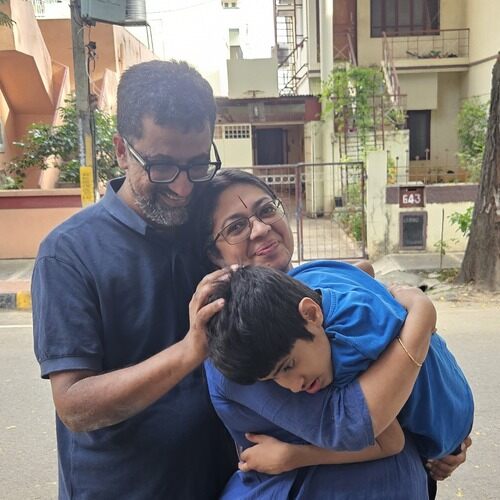
There are moments when I just want to jump into my car and drive away.
Just, away.
All by myself.
There are moments when my husband and I remember our double-income-no-kids days with considerable fondness. We travelled. We ate out. We made plans without first calculating who would stay with whom, what they would eat, how long we could be gone, what might go wrong, and whether whatever we wanted to do was worth the logistical operation required to do it. There are times we wonder whether we should have planned for children earlier. There are roads not taken, decisions we might have made differently, other versions of our lives that occasionally wander into view.
And there is not a moment when we don’t wish for Krishna to have been guaranteed the pain-free, carefree childhood he so briefly tasted.
We still get glimpses of it.
This morning he sprinted down the road to investigate the concrete mixer pouring the roof of the new house nearby. All graceful long skinny legs, fleet like a gazelle, while his father and I chased after him huffing and puffing. There are still moments when something catches his attention and he responds with this completely untextured delight. No complication. No shadow behind it. Just the thing itself and the joy of it.
Those moments seem to get rarer as the days pass.
Of course there is a pang.
I would take his pain away if I could. I would give him that carefree childhood without hesitation. I would change things that have happened to him, and to us. There are lessons I would gladly have remained ignorant of if the price of learning them could have been returned.
But life remains coolly indifferent to my wishes.
Perhaps you have your own version of this.
Perhaps you miss the person who could decide on Friday afternoon to go away for the weekend. Perhaps you miss work, or friends, or sleep, or the ease that once existed between you and your partner. Perhaps you miss a body that wasn’t permanently tired. Perhaps you miss being able to think about something for more than fifteen minutes without being interrupted. Perhaps you simply miss the feeling that your time belonged largely to you.
Or perhaps you don’t particularly want your old life back at all.
You just want this one to be easier.
You want your child not to hurt. You want a full night’s sleep. You want someone competent to take over for a few hours without your having to organise, instruct and supervise the taking over. You want more money, more help, fewer appointments, less uncertainty. You want to leave the house without planning a small military operation.
Or perhaps what you long for is the apparently more familiar parenting life you see around you.
Not necessarily an easier one. Parents of neurotypical children have worries, heartbreaks and problems of their own. But the territory can feel more travelled. Someone has been here before. You have seen versions of the story. There are maps, however imperfect. Autism parenting can sometimes feel like stepping off that familiar path into territory where the answer to far too many important questions is simply: we don’t know yet.
The unknown has a weight of its own.
Sometimes when we say, “I don’t know who I am anymore,” perhaps part of what we mean is simply: I miss things about the life I used to have. Or I wish I had some idea what this life was going to ask of me next.
That is not quite the same thing as having lost ourselves.
If I actually had the power to reverse the clock all the way back—to before Krishna—would I?
No.
Never.
Despite the pain and heartbreak. Despite the anger and fear. Despite the mind-numbing, bone-deep exhaustion.
I don’t know if that is every parent’s answer. It doesn’t need to be.
But there is also the rather inconvenient fact that none of us can reverse reality anyway.
Which makes another question more useful: If we are going to look honestly at what this life has cost us, can we also look honestly at what living it has made possible in us?
Have I really gained only bone-deep exhaustion and pain?
Have I not also experienced love so deep it hurts? Have I not glimpsed beauty so exquisite it brings tears? Have I not received affection so tender, so pure, that I would move hell and earth—not heaven and earth; heaven can stay exactly where it is—to retain it?
This is not an argument for suffering.
I have never understood the need to make suffering earn its place in our lives by turning it into a gift. Some things are simply painful. Some experiences teach us things at prices we would gladly have declined to pay. I don’t need Krishna’s pain to have been necessary in order for the love that exists alongside it to be valuable.
Nor is there some ledger in which we can put the losses in one column and the gains in another and calculate whether life has, on balance, been worth it.
That isn’t how a life works.
But the person who exists today has lived all of it.
The pain. The love. The fear. The tenderness. The exhaustion. The absurdity. The things we wish had never happened and the people without whom we cannot now imagine the world.
The person we were before parenthood had not lived any of this yet.
Perhaps that person is a little like the child we once were.
We can remember childhood with enormous tenderness. We can miss its freedom, its pleasures, people and places that no longer exist. But we don’t usually spend adulthood trying to become that child again.
We grew.
The child we were wasn’t discarded. Some things they loved are still here. Some disappeared. Some became more important. Some things they believed with complete certainty now make us smile. There may be parts of that child we would do well to retrieve.
But we cannot become that child again without erasing everything that happened between then and now.
Perhaps our pre-parent selves deserve the same tenderness.
Remember the person you were before parenthood. Remember their freedom, their dreams, perhaps even their innocence about what life could ask of them. Miss them when you do. Bring forward what still belongs.
And perhaps give up the expectation that you can become them again.
Not because that person was frivolous or immature. People without children are no less adult, no less capable of sacrifice, no less acquainted with responsibility. Long before parenthood, people care for ageing parents, dependent siblings, partners and friends. They carry families, businesses, illnesses, debts and responsibilities invisible to everyone around them.
But becoming responsible for a human being you have brought into the world introduces another dimension.
Another person’s vulnerability becomes woven into your own existence.
And for many parents, that responsibility gradually changes shape as the child grows. The toddler who needs you for everything becomes the child who needs you for some things, the teenager who would prefer to need you for nothing, and eventually an adult with a life increasingly separate from yours.
Autism can complicate that imagined handover.
For some families it simply happens differently. For others it may be delayed. And for some, complete independence may never come.
So while another parent is wondering what secondary school their six-year-old might attend, an autism parent may already be wondering who will keep this child safe when they are thirty-five. Who will understand them when I am seventy? What happens when I die?
Parenthood changes us. The possibility of lifelong caregiving can intensify that change.
And somewhere inside years of appointments, school meetings, therapies, research, meals, medications, meltdowns, forms, advocacy, sleep deprivation, gut issues, celebrations, disappointments, progress, regressions, laundry and trying to remember whether anyone has eaten a vegetable today, a parent can look up and think:
I don’t know who I am anymore.
The usual answer is to tell us to find ourselves again.
Remember what you loved before children. Return to your hobbies. Go out with friends. Take time for yourself. Practise self-care.
There is nothing inherently wrong with any of those things. I am very much in favour of an uninterrupted cup of tea.
But perhaps the problem is not that we have lost the person we once were.
Perhaps we have been so busy living that we haven’t had time to meet the person we have become.
Because of course we have changed.
Everything does.
Our bodies change. Our relationships change. Our children change. Our work changes. Our capacities change. What frightens us changes. What delights us changes. Things that once seemed desperately important become strangely irrelevant. Things we barely noticed acquire enormous significance.
Some changes arrive overnight and announce themselves loudly. Others happen so slowly that we notice them only when we look back and realise how far we have travelled.
Why should the self be the one thing we expect to stand still?
Perhaps what is particularly difficult about the changes that come with caregiving is that so many of them were not chosen.
We may have chosen parenthood. We did not choose every reality that followed.
We did not sit down with a catalogue and select the fear, exhaustion, uncertainty, changed relationships, financial pressures or years of navigating systems. We did not choose our child’s pain. We did not choose all the ways in which these things would change us.
But changed we are.
There are things we have seen now that our earlier selves had never seen. Things we know that they didn’t know. Things we notice that would once have passed us by. Certainties we may no longer possess. Questions we had never thought to ask.
We may understand vulnerability differently. Dependence differently. Dignity differently.
Fear differently.
Achievement differently too.
Things most people barely notice can represent months or years of work. Something tiny can become enormous. Joy and grief turn out to have very little respect for the neat categories we try to put them in. We discover that it is possible to be frightened and hopeful at exactly the same time. To be exhausted by someone and ache with love for them. To desperately want a different reality and still love the life that exists inside this one.
None of this automatically makes us wiser.
Experience does not confer moral superiority. Parenthood does not magically make people better human beings than people who don’t have children, and suffering certainly doesn’t.
Experience merely gives us material from which wisdom can grow.
What we do with the material remains up to us.
And perhaps that is where the question begins to change.
Not:
How do I get myself back?
But:
Who am I now?
Who am I becoming?
And eventually:
Who do I choose to become?
That last question can sound almost insulting if we aren’t careful.
Choice is not distributed equally.
It is easy to talk expansively about agency when there is money, health, respite, family nearby, a supportive partner and competent people with whom a child can safely be left.
It looks very different for a single parent who has to work, whose child needs constant supervision, who cannot afford private care, who has been sitting on a government waiting list for two years and whose family either cannot or will not help.
Sometimes the field of choice is very small indeed. And sometimes exhaustion makes even the choices that remain almost impossible to see.
Agency is not pretending otherwise. It is not insisting that if only we had the right attitude, every possibility would open before us.
Sometimes it begins by asking what is actually consuming our capacity. What genuinely cannot change, and what might? Who knows how close we are to our limit? What happens if nothing changes for another six months, another year, five years?
Perhaps the question is not simply, “How much more can I endure?”
It is: “What will happen if I continue enduring this at the present level?”
We shouldn’t have to discover the limits of our capacity only after we have broken them.
Sometimes recognising, “I cannot continue exactly like this,” is itself an act of agency.
It doesn’t magically create respite, money, services or another competent adult. Sometimes the help we need genuinely does not exist yet. Sometimes systems fail families badly. But naming the limit may allow a different set of questions to emerge. What help have I not found? What can someone else carry? What have I assumed cannot change? Is there any way, however small, to widen the field?
Sometimes there may be.
Sometimes the available choices may remain painfully inadequate.
That too is reality.
But agency does not require unlimited choices. It begins with seeing as clearly as we can what choices exist, what might be changed, and where we may need other people to help us see possibilities that exhaustion has hidden.
Possibilities not just for our child. Possibilities for ourselves too.
And those choices do not all have to be productive.
Because even the project of “finding yourself” can become another job for an exhausted caregiver.
Find yourself. Reinvent yourself. Exercise. Meditate. Learn pottery. Restart your career. Make friends. Discover your purpose.
Good grief. I’m tired just writing the list.
Perhaps alongside asking what we want to do, create, learn, contribute or give, we could ask something else.
What do I want to receive?
Friendship. Attention. Beauty. Food. Music. Rest. Solitude. Someone else’s care. Intellectual stimulation. Desire. Laughter. Rain. An afternoon in which nobody requires improvement.
The ordinary pleasure of being interested in something simply because we are interested in it.
After years of being the person who anticipates, organises, interprets, advocates and cares, receiving can take some getting used to as well.
A life cannot consist entirely of giving and doing, even when the giving is done willingly and the doing matters enormously.
And none of this requires the child to disappear from the picture.
We do not need to construct some separate, pristine “me” untouched by parenthood. Our children are part of the people we have become. So are the painful things. So are the beautiful ones. So are the people we were before them.
We have always existed in relationship anyway.
Child. Sibling. Partner. Parent.
The question is not how to become a person untouched by those relationships.
It is how to remain a person within them.
Losing yourself in love is not the same as giving yourself fully to love.
And sometimes it isn’t love that has consumed the self at all. Sometimes there has simply been too much caregiving and too little help for too long.
That matters.
Deep emotions and relentless demands exhaust our puny human frames.
We cannot live permanently in emotional exaltation. We cannot spend every hour contemplating the exquisite depth of parental love. Nor can we live permanently inside fear, grief or despair.
Eventually somebody needs lunch.
The electricity bill needs paying. The washing machine finishes its cycle. Our backs hurt. Someone rings the doorbell. There is traffic. We want tea. We want to talk about something that has absolutely nothing to do with autism.
Perhaps this ordinary return is not a retreat from love.
Perhaps it is part of sustaining the person who loves.
I no longer find the idea of “getting myself back” particularly compelling.
Which self would I get back?
The woman who had never met Krishna?
The woman who had never known this particular fear, this particular tenderness, this particular exhaustion, this particular delight?
Of course I miss things about her life. Sometimes fiercely.
I remember her fondly.
I sometimes envy her.
There are things she knew how to enjoy that I would like to carry forward. There are parts of her I hope I never lose. There are other things I am quite content to leave behind.
But wanting pieces of that life back is not the same as wanting to turn back the clock.
Because turning back the clock doesn’t only return my freedom.
It takes away everything—and everyone—that came afterward.
So perhaps we don’t need to recover ourselves.
Perhaps we need to meet ourselves.
Who am I now?
Not who should I have been. Not who would I have been if life had unfolded differently. Who is actually here?
Who am I becoming?
If I continue living exactly as I am living now, carrying what I am carrying in the way I am carrying it, where is this taking me?
And who do I choose to become?
Not in some imaginary life without constraints.
This child. This family. This body. This bank balance. This amount of help. These responsibilities. This particular Tuesday afternoon.
There may be considerable room for choice. There may be very little. There may be places where some room can be made, and others where reality remains stubbornly immovable.
But reality will not remain exactly as it is either.
Nothing does.
Some changes come suddenly. Others happen over years, almost imperceptibly. Life changes around us and through us, whether we are paying attention or not.
We cannot choose whether life changes us.
But perhaps we can participate in how we change.
We can meet the person who is here now and, from time to time, look up long enough to notice where they are going.
And then life interrupts.
Somebody needs lunch. The phone rings. There is laundry waiting. Somewhere down the road, something interesting is happening and a boy with long skinny legs has already taken off to investigate.
And we follow.
Still becoming as we go.
I think this is very close now. The next pass, if we do one, should be sentence-level only: rhythm, word choice, punctuation, and any places where your ear catches something that doesn’t quite sound like you.