
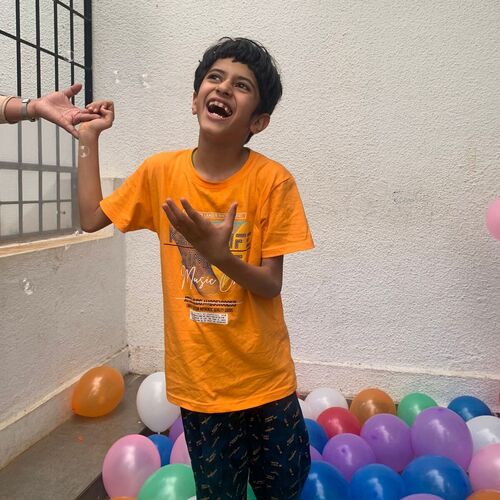
“Krishna is on the autism spectrum,” the doctor said.
The words hit me like a freight train.
Once I got over the shock, I assumed that a year or two of therapy would “set him right.” He might lose a couple of years, but eventually he would find his way back to the familiar, well-trodden path of mainstream life as we know it.
It was not to be.
Over the years, Krishna slowly regressed from what was once described as “mild” autism to profound autism.
Where did that leave me?
Feeling helpless.
A powerless failure.
But then, when we say “bring up a child,” what is actually within in our conscious control? What is the power that we actually have, in any circumstance? What is the one thing that we can control completely?
Sandwiched as I am between neuroregression in Krishna and neurodegeneration in my parents, I have spent more time than is probably healthy wondering whether we are little more than elaborate soups of neurochemicals. A grand bubbling concoction of neurons, neurotransmitters, myelin sheaths and electrical signals, where the wrong proportion of one ingredient sends the entire recipe off course.
The thought is not particularly comforting.
Yet here we are.
The equation I carried into autism was simple enough.
Effort in. Outcome out.
Therapy in. Progress out.
Love in. Better future out.
Reality, however, turned out to be considerably less cooperative than that.
Krishna’s autism seemed to have a mind of its own. Definitely an identity of its own. One that paid scant regard to my plans, my hopes, or my equations.
The Villain
One of the most terrible feelings in the world is the helplessness of a parent watching their child in pain.
Krishna’s gut behaves like his worst enemy, the nastiest storybook villain you can think of. Just when he seems to have won a battle with migraine or dental pain and settles into happiness, his gut says, “Be happy, will you? Just you wait.”
I watch him writhe in pain.
I block his self-injury.
I yell when it turns into aggression.
And somewhere underneath all of it lurks a question.
What is the use of my being his mother if I cannot even protect him from pain?
The pain isn’t gone today.
Neither his nor mine.
What has changed is that I have made my peace with having to experience it while doing everything that is humanly possible to alleviate his suffering.
And this is power.
This is agency.
Not giving up and weeping. And not because I can make the pain disappear or control the outcome.
But because when everything else fails, I can still be there.
I can still be his mother through the pain.
Sometimes that looks like yelling at him to stop hitting his head.
Sometimes it looks like gathering him into my arms and rocking him while he sobs.
Sometimes it looks like holding a boundary.
Sometimes it looks like offering comfort.
Always, it looks like staying.
Showing him that I will always be his rock, his anchor, even when it seems like I am scolding him.
Showing him that the villain is the problem.
Never him.
The pain is the problem.
The suffering is the problem.
The aggression is the problem.
Never him.
My love for him does not waver because his nails dig into my leg or his teeth sink into my arm.
And this is power.
This is agency.
My victory is no longer measured only by the absence of pain.
Sometimes it is measured by watching Krishna struggle and find the strength to control the aggression without chemical help.
Sometimes it is measured by both of us enduring something difficult together and coming out the other side.
The Future Remained Stubbornly in the Future
The exhaustion, the fear, the despair can forge a powerful mindset of agency: detached action.
Detached not from love or the desire to better your child’s future.
Rather, the action is rooted in this very love and desire, which hone focus on what is happening now. On what lies within your control. On your choices today. Your decisions today.
Without getting lost in the morass of what-ifs.
Will Krishna speak?
Will he become independent?
Will this therapy work?
Will I make the wrong decision?
Will I regret this later?
I have spent years wandering through those questions.
The future remained stubbornly in the future, but the present was definitely mine.
Diapers and Other Things I Could Not Control
For years, I tried to retrain Krishna in bladder control; his losing it was the very first sacrifice at the altar of his regression.
The thought of him being in diapers for life horrified me. The fate threatened by advocates of “take him to the loo every ten minutes.”
No doubt excellent advice for toilet training, but not particularly useful for a child whose brain had stopped signaling bladder fullness before it was too late.
I religiously took him to the loo every ten minutes for almost a year.
And then I finally accepted it was no use.
This was something absolutely beyond my control.
What was in my control was to stop obsessing about diapers.
As long as Krishna needs them, he gets them.
A day may come when he doesn’t.
If so, wonderful.
If not, it isn’t the end of the world.
Futures That Break Your Heart
My husband once came home after a conversation with colleagues about board examinations.
The visceral pang he felt surprised him. Nobody exactly loves board exams. Neither parents nor children.
And yet.
“I can never tell Krishna I don’t care about his board results. That he can just be himself.”
The grief wasn’t really about examinations.
It was about a future.
One of the many futures we had imagined before autism rewrote the script.
That’s the thing about imagined futures. They are powerful enough to break your heart and leave you feeling powerless. They stir you up till you start feeling that the loss of the imagined future is the loss of all future.
So what is it that we can do to seize back that power, because it belongs to us; not some imagined future that had no life outside of our imagination?
Especially when the imagination doesn’t feel imaginary in the least. When the imagination is of life trajectories that have unfolded for generations in the lives we know.
We have lived them ourselves. We have watched our siblings, cousins and friends live them. We have imagined our children walking the same well-trodden road.
Board examinations.
College.
A first job.
A wedding.
Children of their own.
These are not castles in the air. They are the ordinary milestones of an ordinary life. Which is precisely why loosening our grip on them feels so hard.
It can feel as though we are giving up on our child.
We are not.
We are giving up only the illusion that our power lies in guaranteeing that future. That power has always lived somewhere else. And reclaiming it takes work.
Sometimes the hardest work we will ever do.
So where does that power lie?
The Things That Are Mine
For me, there are three kinds of things in life.
Things that are mine.
Things that are partly mine.
And things that are not mine at all, however passionately I may wish otherwise.
My actions are mine.
My effort is mine.
My learning is mine.
My choices are mine.
Whether I apologise after a meltdown is mine.
Whether I advocate for Krishna is mine.
Whether I rest, when rest is available, is mine.
Speech is partly mine. I can support communication. I cannot manufacture language.
Gut pain is partly mine. I can investigate. Experiment. Advocate. I cannot guarantee relief.
The future is not mine. No matter how often I revisit it at three in the morning.
Rather, my three in the morning is better spent sleeping if Krishna is sleeping. Or, if my nervous system refuses to let go, reading fiction to escape for a while.
The Greatest Theft
Every piece of energy spent wrestling things that weren’t mine left me with less energy for the things that were.
The cost was capacity.
The capacity to enjoy Krishna dancing in the rain now, instead of worrying whether tomorrow he would scream “viilaa!” in sheer exuberance when the wind threatens to blow him away, or be fighting with me tooth and nail, literally, to escape and bash his head against the wall.
The capacity to notice that now, when I ask him whether he wants to lie in the grass or go for a joyride in the car, he chooses to get up, gently take my hand, and lead me out. Instead of worrying about when he will use the PECS system to point to the picture of the car.
The capacity to switch my emotions from screaming, “Stop hitting your head!” to scooping him up when he sobs, hugging him close, and singing to him.
The capacity to walk this path for the rest of time.
And perhaps that is the greatest theft performed by fear. Not the fear itself, but the way it consumes resources we desperately need elsewhere.
The Present Is Definitely Mine
The future remains important.
Of course it does. I am a parent. Worrying about the future is practically part of the job description. But the future is not where my power lives.
My power lives here.
In this decision. In this action. In this moment. With this child.
The future remains stubbornly in the future but the present is definitely mine.