
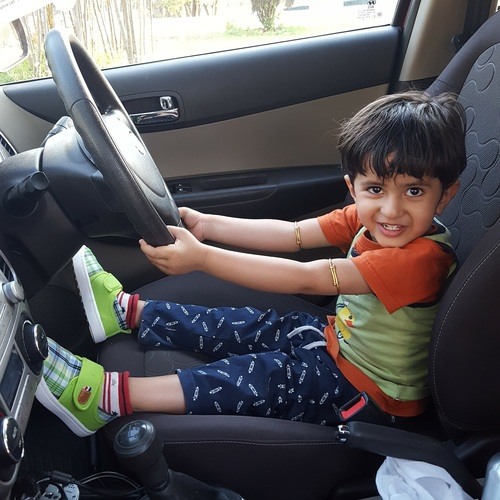
Why Parents search for answers beneath the spectrum
There is a particular kind of archaeology that begins after an autism diagnosis.
Parents become historians of tiny forgotten moments. We begin excavating old pregnancies, old prescriptions, old scans, old fevers, old memories that had once dissolved into ordinary life. A bleeding episode at fourteen weeks. An injection whose name we no longer remember. Antibiotics. Vaccines. A fall. A period of stress. A strange illness. A missed developmental sign that only seems obvious in retrospect because hindsight edits memory with cruel precision.
Especially when the child’s suffering is severe enough that “acceptance” alone does not answer practical questions.
Years later, we sit in the dim light of our phones searching medical journals at two in the morning, trying to reconstruct causality from fragments.
Did I do this?
Could I have prevented it?
Can I still help him?
I know this landscape intimately.
Recently, Veena Aiyer shared an article by Luca Foschini describing his family’s thirty-seven-year diagnostic odyssey for his brother Guido, who was eventually diagnosed with Phelan-McDermid Syndrome. As I read it, I felt an almost physical jolt. Krishna’s story is eerily similar to Guido’s in ways I cannot shake off. The regressions. The medical complexity. The long wandering through partial explanations and disconnected symptoms before genetics began tying pieces together.
So I met Krishna’s geneticist again last Thursday.
She is now revisiting the raw data from Krishna’s earlier genetic testing to see whether newer interpretations or additional information can be extracted from it. Science moves quickly in this field. Data that appears meaningless one year may become clinically significant a few years later as research evolves and more gene-pathway relationships are understood.
We sat there discussing Krishna again, almost like reconstructing a complicated neurological weather system across time. His three major regressions. Their timelines. The strange patterns that only become visible when years are laid side by side. She mapped thirteen major issues Krishna faces against his TCF20 and TANC2 mutations and explained how many of them plausibly align with what is now being understood about these pathways.
Then she gently suggested something that shook me more than I expected.
She said that perhaps, in a few years, we may need to consider a permanent G-tube to help meet Krishna’s nutritional needs.
She told me about another mother who resisted the idea for years, unable emotionally to accept the thought of a permanent tube in her child’s abdomen, until the child eventually became severely emaciated.
And I understood something important in that moment.
Medical interventions are not only clinical decisions. Parents need time to psychologically arrive there too. We need time to understand what may be coming, what signs to watch for, what possibilities may eventually need consideration. Sometimes knowledge is not only about treatment. Sometimes it is about emotional preparation.
And I would never even have encountered this conversation had I not followed up with the geneticist out of sheer desperation to understand Krishna’s future better. To understand how to improve his health, stamina, comfort, and long-term quality of life.
This, to me, is the real purpose behind understanding the possible biological pathways underlying a child’s autism.
Not blame.
Not rejection.
Orientation.
That entire weekend afterward, I found myself feverishly searching through research papers and medical discussions trying to understand what exactly autism even means biologically today.
Because autism itself is still diagnosed largely from external presentation. The “front end.” The behaviors we can observe: communication differences, repetitive behaviors, sensory profiles, developmental delays, social interaction patterns.
But what is happening at the “back end”?
What biological pathways are producing these outward expressions?
And the deeper I go into the literature, the clearer it becomes that autism is probably not one thing at all.
It may be many different neurodevelopmental pathways arriving at overlapping outward behaviors.
Autism As We Currently Understand It
Autism may eventually need to be understood across three separate but overlapping layers:
1. External Expression
What we observe outwardly:
- social communication differences
- sensory differences
- repetitive behaviors
- emotional regulation difficulties
- speech and language differences
- executive dysfunction
2. Developmental Trajectory
How the condition unfolds over time:
- mostly non-regressive presentations
- regressive presentations
- medically complex presentations
- mixed presentations
3. Underlying Biology
What pathways may be contributing underneath:
- genetics
- neurological circuitry
- immune pathways
- gut-brain interactions
- metabolic pathways
- prenatal developmental factors
- unknown mechanisms
And if the underlying biology differs dramatically from child to child, the future of autism care cannot remain one-size-fits-all forever.
Broad Clinical Expressions Within Autism
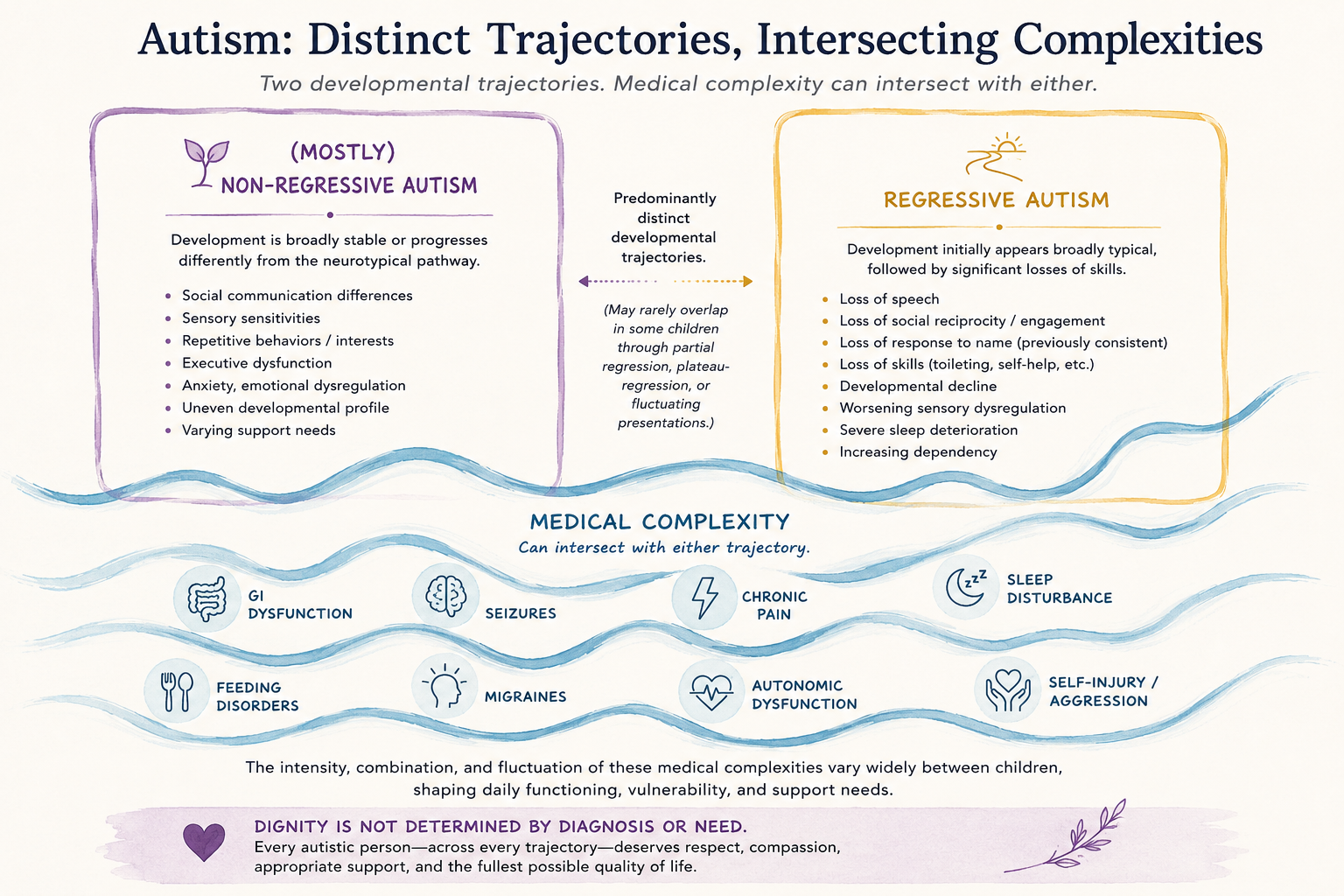
1. (Mostly) Non-Regressive Autism
(for lack of a better shorthand, not a formal diagnosis)
This may involve:
- social communication differences
- reduced or inconsistent response to name
- differences in eye contact or social gaze
- sensory sensitivities
- repetitive behaviors
- executive dysfunction
- anxiety
- uneven developmental profile
- restricted interests
Possible associated challenges:
- shutdowns
- sensory overload
- burnout
- emotional dysregulation
- anxiety disorders
- depression
Some individuals within this broad grouping may study, work, live independently, form relationships, and require varying degrees of support and accommodation.
Possible pathways may include:
- genetic/genomic pathways
- neurological circuitry pathways
- immune/inflammatory pathways
- gut-brain pathways
- prenatal/developmental pathways
- unknown pathways
2. Regressive Autism
In some children, development initially appears broadly typical before significant losses emerge.
This may involve:
- loss of speech
- loss of social engagement
- loss of previously consistent response to name
- loss of social reciprocity
- loss of toileting/self-help skills
- developmental decline
- worsening sensory dysregulation
- severe sleep deterioration
- increasing dependency
Krishna himself was first diagnosed with Childhood Disintegrative Disorder during our second-opinion consultation, long before later genetic findings began offering partial biological explanations. Regression was central to the clinical picture. Loss was central to the clinical picture. The trajectory mattered.
Possible pathways may include:
- genetic syndromes
- neuroimmune/inflammatory pathways
- epilepsy-related mechanisms
- mitochondrial/metabolic dysfunction
- gut-brain pathways
- inflammatory processes
- unknown pathways
3. Medically Complex Autism
Some autistic children experience substantial multisystem medical involvement alongside developmental differences.
This may involve:
- chronic GI dysfunction
- feeding disorders
- nutritional compromise
- chronic pain
- migraines
- seizures
- autonomic dysfunction
- severe sleep disturbance
- self-injury
- aggression
- motor difficulties
- profound dependency
Medical complexity may overlap with both regressive and non-regressive autism trajectories.
Possible pathways may include:
- syndromic/genetic conditions
- immune dysfunction
- gut-brain interactions
- metabolic and mitochondrial dysfunction
- autonomic nervous system dysregulation
- neurological injury or instability
- unknown pathways
Overlap Exists
Of course, these categories are not cleanly separate.
A child may occupy several simultaneously.
Both non-regressive and regressive presentations may involve:
- sensory differences
- communication difficulties
- repetitive behaviors
- GI dysfunction
- sleep disorders
- anxiety and dysregulation
And similar outward behaviors do not necessarily imply identical underlying biology.
Genetics, immunity, metabolism, gut function, sensory processing, and brain development constantly interact with one another. These are not isolated silos.
As I read, the emerging pathways gradually organized themselves in my mind into categories that I wish someone had explained to me years ago.
The Major Biological Pathways Being Studied In Autism
1. Genetic / Genomic Pathways
This is currently considered one of the strongest known contributors to autism overall.
Includes:
- rare single-gene syndromes
- copy number variations (deletions/duplications)
- polygenic autism involving many small genetic influences
- de novo mutations not inherited from parents
Common associated features:
- developmental delay
- speech delay or loss
- intellectual disability
- seizures
- sleep disorders
- GI dysfunction
- migraines
- sensory dysregulation
- motor difficulties
Examples of genes being studied:
- TANC2
- TCF20
- SHANK3
- CHD8
- SCN2A
In children like Krishna, these pathways may affect not just behavior or communication, but multiple body systems simultaneously.
2. Prenatal / Developmental Pathways
These involve factors affecting the developing fetal nervous system during pregnancy.
Possible contributing factors being studied:
- maternal immune activation
- severe infection or inflammation
- placental complications
- prematurity
- oxygen deprivation
- metabolic stress
- certain prenatal medication exposures
These are usually considered risk-modifying pathways rather than single direct causes.
And to mothers carrying guilt over pregnancy complications, infections, medications, stress, bleeding, prematurity, or events beyond their control: please understand that biology is not a moral judgement. Unless you were deliberately trying to harm your child, you were almost certainly doing what all mothers do: surviving pregnancy while loving your baby the best you could.
3. Neurological / Brain Circuitry Pathways
This category focuses on how the nervous system itself develops and functions.
Areas being studied:
- synaptic functioning
- sensory processing
- cortical connectivity
- excitatory/inhibitory balance
- motor planning
- cerebellar functioning
- predictive processing
Possible outward expressions:
- sensory overload
- motor coordination problems
- emotional dysregulation
- shutdowns or meltdowns
- repetitive behaviors
- attention differences
- interoception difficulties
This may explain why autism affects far more than social interaction alone.
4. Immune / Inflammatory Pathways
An evolving but increasingly important area of research.
Includes investigation into:
- neuroimmune signaling
- chronic inflammation
- mast-cell activation
- cytokine differences
- autoimmune associations
Common parental observations:
- behavioral worsening during illness
- inflammatory flares
- eczema/allergies/asthma
- sudden regressions after infections in some children
Science is still evolving here, but immune-brain interactions appear increasingly relevant.
5. Gut–Brain / GI Pathways
One of the most clinically significant areas for many families.
Common associated issues:
- constipation
- reflux
- diarrhea
- SIBO
- feeding difficulties
- restrictive eating
- abdominal pain
- nutritional compromise
Possible mechanisms:
- gut motility differences
- enteric nervous system involvement
- microbiome alterations
- immune signaling
- metabolic effects
For some children, gut distress may dramatically worsen behavior, sleep, sensory tolerance, and overall functioning.
6. Metabolic / Mitochondrial / Cellular Energy Pathways
A smaller but important subgroup.
Common associated features:
- fatigue
- migraines
- exercise intolerance
- developmental regression
- heat sensitivity
- fluctuating functioning
- multisystem involvement
The nervous system is extraordinarily energy-intensive. Problems in cellular energy systems may significantly affect neurodevelopment.
7. Regression As A Clinical Pattern
Regression is not necessarily a single cause or pathway in itself, but a recognizable developmental pattern seen in some autistic children.
Some children:
- develop relatively typically for a period
- then lose speech, regulation, social engagement, or other skills
Possible associated mechanisms being explored:
- immune activation
- epilepsy
- metabolic dysfunction
- genetic vulnerabilities
- mitochondrial stress
This remains one of the most emotionally difficult and scientifically unresolved areas in autism research.
8. Unknown / Not Yet Understood Pathways
Perhaps the largest category of all.
Many autistic children still have no clearly identifiable mechanism despite extensive testing.
That does not mean:
- “nothing biological is happening” or
- “parenting caused it.”
It simply means neuroscience is still early.
Different Is Not Less. But Different Realities Still Exist.
The more I learn, the more I realize how differently two autistic children may experience life beneath the same diagnostic label.
And this, perhaps, is one of the biggest tensions in modern autism conversations.
The original push toward “different, not less” emerged for very good reasons. For decades, autistic children were treated as broken, morally deficient, emotionally empty, badly parented, or socially disposable. Many autistic individuals who could absolutely learn, work, communicate, form relationships, and participate meaningfully in society were denied dignity and accommodation because autism itself was seen as evidence of inferiority.
Parents and autistic adults pushed back against that narrative. Rightly.
They insisted that autistic people had emotional depth, inner lives, rights, and value. They insisted that difference was not inferiority.
I believe that too.
I do not believe children like Krishna are “less” in any human sense. In fact, I often think children carrying such immense neurological and physical burdens display a level of endurance most of us can barely comprehend. Every tiny milestone can represent immense labour: sensory regulation, motor planning, communication effort, autonomic control, pain tolerance, cognitive persistence. What appears small from the outside may feel, inside their nervous systems, like scaling Everest barefoot.
At the same time, not every autistic person experiences autism primarily as suffering.
For some individuals, autism may manifest mainly as differences in social communication, sensory processing, attention regulation, or executive functioning while still allowing substantial independence, education, work, relationships, and self-determination.
But at the other end of the spectrum are children living with severe medical, neurological, cognitive, and physical burdens alongside autism: chronic pain, GI dysfunction, inability to communicate distress, loss of speech, sleep disorders, seizures, aggression, self-injury, nutritional compromise, lifelong dependency, and intense vulnerability.
These are not identical realities.
And unless we are willing to classify and study these realities more precisely, we will struggle to develop truly meaningful therapies, supports, medical interventions, and future care models for the children who need them most.
Classification is not about assigning human worth.
It is about understanding suffering accurately enough to reduce it.
We already have the concept of neurodiversity as a broad framework acknowledging natural variation in human nervous systems and cognition.
But broad dignity-based language and precise medical classification are not mutually exclusive.
In fact, medicine progresses through refinement.
Historically distinct diagnoses like Childhood Disintegrative Disorder (CDD) and Pervasive Developmental Disorder – Not Otherwise Specified (PDD-NOS) were eventually folded into Autism Spectrum Disorder despite sometimes sharing surprisingly little developmental similarity beyond overlapping outward behaviors.
A child who loses language, toileting, and developmental skills after years of apparently typical development may inhabit a profoundly different biological reality from someone whose autism primarily involves social communication differences and executive dysfunction.
Both deserve dignity.
Both deserve support.
But they may not represent the same underlying condition at the biological level.
And unless we continue refining autism classifications biologically and clinically, we may struggle to study these pathways clearly enough to develop truly targeted therapies and supports.
Today, a fully verbal autistic adult with a successful career, relationships, and independent living skills may carry the same diagnostic label as a child who cannot communicate pain, cannot sleep, cannot toilet independently, lives with severe GI disease, experiences debilitating sensory overload, struggles with aggression or self-injury, and may require lifelong full-time support.
And yet their needs are profoundly different.
Higher support needs do not imply lesser humanity, emotional depth, sentience, or worth.
A human being does not lose dignity because their nervous system cannot express itself fully.
Medicine cannot advance through vagueness forever.
Sitting beside a child in pain and saying “he is just different” is sometimes not compassion.
Sometimes it is avoidance.
Why Parents Continue Searching
Parents follow research obsessively not because they are incapable of acceptance, but because they are trying to build the best possible lives for their children inside a rapidly evolving scientific landscape.
They are watching developments in genetics, microbiome research, communication technologies, sleep medicine, sensory regulation, neurology, precision medicine, assistive devices, AAC systems, and neurodevelopmental science because today’s impossible may not remain impossible forever.
Hope is not stupidity.
It is survival.
And perhaps one of the most important distinctions we need to preserve in all these conversations is this: many parents are not searching for a cure for identity.
They are searching for relief from suffering.
Those are not the same thing.
Krishna
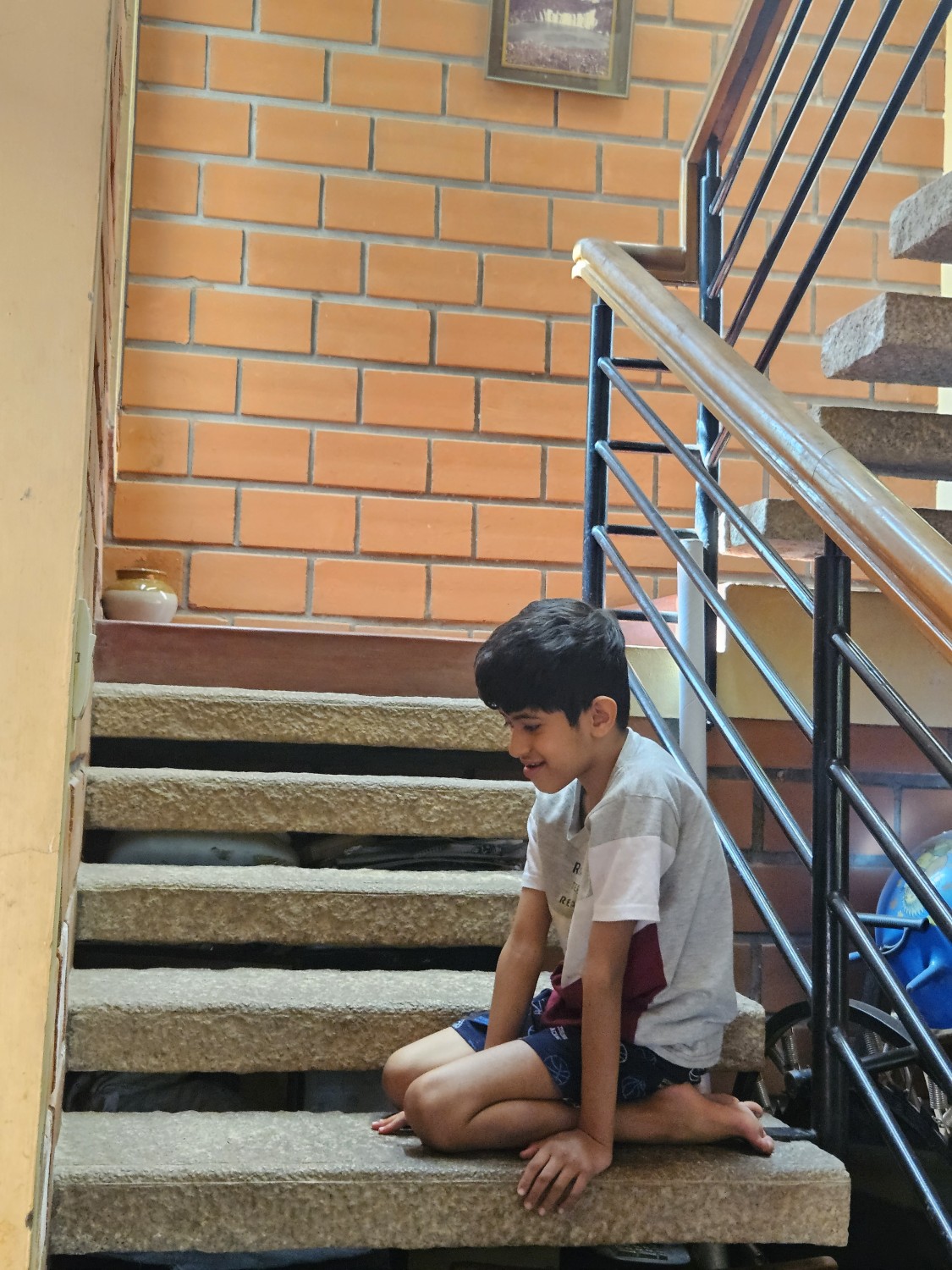
I do not want to erase Krishna. I do not want to flatten his personality into neurotypicality. I do not want to extinguish the vivid, curious, mischievous, deeply alive child that he is.
Because despite everything his body struggles with, Krishna himself remains full of joy. Full of wonder. Full of startling curiosity. There are moments when he laughs with such complete abandon that the whole house rearranges itself around him. Moments when his eyes light up with recognition or delight or triumph after accomplishing something his nervous system makes unimaginably difficult. Moments when tenderness appears so suddenly and purely that it catches me off guard even now.
That is the real Krishna.
Not the diagnosis.
Not the suffering.
Not the losses.
Him.
And so I live in both realities at once.
I celebrate him fiercely.
And I will continue hoping, researching, learning, and fighting for anything that may reduce the burdens his body carries.
Both are my truths.