
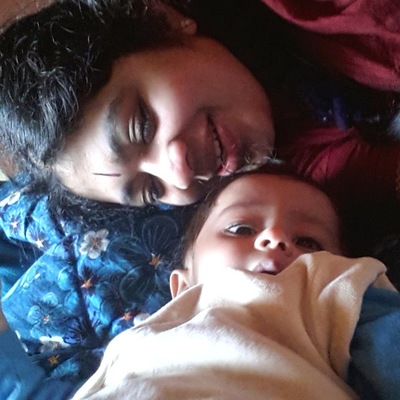
“But why me???”
I too cried this question out to the universe when Krishna was diagnosed as autistic.
And many times after that, whenever it all became just too much to handle.
I could answer myself in two ways:
Why not me?
And—
Did I ask “why me” when people were praising baby Krishna for being alert, responsive, and handsome?
The “why me” cropped up when I envied others for their neurotypical children. This was easy enough to let go of once acceptance set in.
The “why me” appeared again when Krishna was in pain, especially before his dental procedure. This time, it came from helplessness in the face of his suffering—and the guilt that I was failing in my duty as a parent to protect him.
The way out then was to push past the helplessness and guilt by doing everything within my control: giving him medicines, distracting him, sitting with him, sharing his pain, and showing him that he wasn’t alone.
The “why me” surfaced yet again when I was exhausted, cleaning up after Krishna.
This was the easiest instance to answer:
If not me, then who?
Krishna is who he is, for whatever reason.
Was I—am I—willing to let anyone else be responsible for him, as long as I am around?
The answer is, and will always be, a resounding no.
And then I realised something.
The moment I began asking “why me,” I had slipped into complaining.
And no complainer creates or achieves anything.
I had a choice.
I could continue complaining.
Or I could take responsibility for my responses, and consciously choose them.
I may not have control over the situation.
But I do have control over myself.
And those responses, in turn, shape the outcome—at least to some extent.
Krishna was still in pain, despite the medicines.
But he was visibly comforted when I sat with him, or ran with him through the night.
He knew he wasn’t alone.
Amma would be with him through the worst of it—even when he was hurting himself, or hurting me.
And in that, there was a moment of gratitude.
I was helping Krishna—simply by being there.
Where, then, was the space for “why me”?
It became irrelevant.
There is immense power in flipping your story—from complaining and reacting, to taking charge and responding.
And doing it every day, until it becomes a habit.
Like brushing your teeth.
Have you felt this?