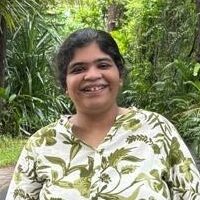

I am an author—an award winning author of fiction and this is the identity that I own with pride. Incidentally, the process of getting here involved quashing a few widely held myths about non-speaking autism and this is something that I have learned to take in my stride. It is also something that made me think about the ways in which I could use my voice to help parents, educators and the community at large to understand non-speaking autism and the need for an alternative mode of communication better.
I have had the opportunity to interact with middle schoolers and their educators of a reputed school in my city that is affiliated to the IBO, a government school in my city where the students are children of daily wage workers, the educators of government schools from a neighbouring state and the educators, parents and community at large of a school for autistics in a Tier 2 town in my state, among others, in my capacity as a writer of fiction, who is also a non-speaking autistic.
One thing that I realised in my interactions with these diverse groups is the kind of questions that came from the audience was very similar, which got me thinking about the widespread prevalence of stereotypes.
Here are some questions that stood out for me.
“For a non-speaker, you possess very good language and you even write fiction. How did you build on your language skills? If I introduce AAC to a non-speaker, will they, with time, be able to express like you?”
First things first; the ability to use AAC—in my case text-to-speech—and the ability to spin tales are two unrelated things. AAC should be introduced to anybody for whom speech is not a reliable mode of communication. Everybody deserves a voice and an opportunity to be heard. Not being able to communicate even the basic of things is super frustrating and the root cause of ‘problem’ behaviours associated with autism.
It is also a fact that not every non-speaker picks up the ability to type, probably because of dyspraxia and other similar challenges, which is where pictures/symbol based AAC and letter boards come to play. There is something in this for everyone!
I have enjoyed reading from the time I remember. I picked up the ability to read when I was three and observing people and spinning tales are my two favourite pastimes. Learning to type on the laptop gave me a sensorially comfortable mode of putting my thoughts on paper and the warm and encouraging responses that I got for my blogs gave me the impetus to get my stories published. The rest, as they say, is history.
Writing is my passion and like any other craft, it needs practice and fine tuning. Like in the neurotypical world, where different people are good at different things, we non-speakers have varied interests and strengths. But what most non-speakers can achieve with systematic and consistent learning and practice is enough functional language to express clearly in the chosen mode of communication.
“How different are your senses from those of us neurotypicals?”
The fact that we autistics have sensory differences is an open secret. But like everything else with autism, this too is on a spectrum. So a person can be anywhere on the spectrum from hypersensitivity, which is what I have and in tons at that, to hyposensitivity or lack of sensitivity. This again, is in varying degrees and combinations.
So when you set out to understand what my world feels like sensorially, what you will have is only my sensory profile which could be very different from the sensory profile of the next autistic you meet. What helps is to understand that we do certain things the way we do because we experience the world differently and not because we intentionally set out to be rude or defy societal norms. Making accommodations for some of our sensory challenges helps us learn, work and live to the best of our ability.
“All autistics are supposed to be really good at certain things, right? Like music, math…”
The world of autism is replete with stereotypes and mainstream media has done a rather effective job of promoting these stereotypes, right from the movie The Rainman to SRK’s pathetic attempt at portraying an autistic in My Name is Khan to the multiple shows on various OTT platforms that feature autistic protagonists, autism is portrayed as a combination of some very special abilities and glaring inabilities.
This is the farthest from the truth.
As per the latest statistics, 1 in every 100 children in India are autistic. Does that mean 1 in 100 children are prodigal? It is estimated that 40 percent of the autistic population is non-speaking. Does it mean 40 percent of the autistics are poets who write very philosophically?
It doesn’t sound correct because it is not correct.
As per official statistics savants form about 1 percent of the total autistic population. The rest of us, like neurotypicals, fall on the average part of the standard distribution. We each possess our own strengths and challenges and spend our lives balancing the two.
“Do early intervention and therapies even help? Isn’t autism an intellectual disability, in which case what is the point in doing these therapies or spending so much money on assistive technologies?”
Equating autism with intellectual disability is another common occurrence. Autism is not an intellectual disability. It is a socio communication disorder that is caused by our sensory differences which impacts the way we perceive the world, interact with others and learn and live.
Making accommodations for our sensory differences, helping us find our voice and preferred mode of communication and building on our strengths helps us learn and live to the best of our ability. After all, true inclusion, be that in a classroom, a workplace or the society at large, can never be a one size fits all.
Just like the neurotypical population, a small percentage of autistics have intellectual disability. As a society, is it not our responsibility to design meaningful learning and work programs and options for healthcare and independent living for all stakeholders, including those with intellectual disabilities?
The attitude of ‘there is no point’ is surely not helping with that.
“You are able to write so well and do so many things, so the autism is gone and you are cured—but is that a possibility for others?”
Judy Singer, an Australian sociologist, first coined the term neurodiversity in the late 90s. As per her, conditions like autism, ADHD and more are just a different way of experiencing the world. Autism is a not disease to be cured. This is something I wish most parents who fall for snake oil cures and tall claims would understand.
My brand of autism consists of significant sensory hypersensitivities and intense social anxiety. I have learnt to manage these and live a productive life, all thanks to early intervention, accommodations, AAC and CBT to manage debilitating social anxiety.
As an autistic adult, here’s the big change that I hope to see—a change in the mindset of educators, employers and the society at large.
Autism is not a disease to be cured. It is a different way of experiencing life.
Helping us build on our strengths is the first step towards meaningful adulthood for us all.
This article was originally published on Aditi Sowmyanarayan’s personal blog, Small Step Big Thought, and is republished here with the author’s permission.
Connect with Aditi Sowmyanarayanan: Sowmyanarayanaditi@gmail.com