
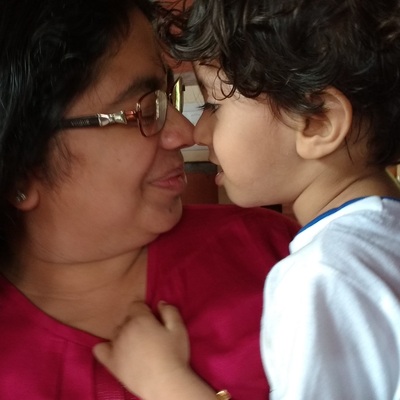
“Krishna, what do birds eat?”
“Pija!” replied 2-year-old Krishna, who was eating pizza at the time.
“You’re eating pizza, baby, and you’re not a bird. What’s your name?”
“Santalagopalakisha!” he promptly giggled.
(Krishna’s “traditional” name is Santanagopalakrishnan. Yes, a huge name for a tiny boy!)
Till he was 3.5, Krishna was very verbal and communicating beautifully.
After his first regression, he would talk to himself for hours on end, in long, cogent, grammatical sentences.
But he wouldn’t ask me anything. He wouldn’t answer me either. He stopped communicating.
“He doesn’t need speech therapy because he’s verbal,” an ABA therapist told us. “Let’s just go with ABA and see if he resumes communicating.”
He didn’t.
So we took him for speech therapy to a centre reputed to be the best in the city.
Krishna didn’t resume communicating, not even a little. But he had great fun in the sessions, and so I continued to take him there.
Wishful thinking poked its nose into my mind and said, give it a little more time…
At the end of 1 year’s therapy, Krishna became nonspeaking.
Not because of speech therapy, of course.
He stopped speaking on the day he underwent a surgical procedure at the age of 4.5. And surgery is a trauma to the body, all said and done. Perhaps it triggered this huge step back.
He hasn’t spoken a single word since then.
His becoming nonspeaking was so sudden, like a switch turned off. And we still don’t know why; neither do the doctors.
At the time, the speech therapists declared that since he was not speaking at all anymore, we should focus on developing his writing skills.
A year later, Krishna regressed again and lost his writing skills too.
And here lies the issue: how do you decide which therapy is right for your child? How do you decide whether to follow the therapist’s advice or not?
Today, I’d tell my younger self this:
“Look for measurable results without mixing in wishful thinking.”
“Your main goals should be teaching your child to communicate and be self-reliant. This can be in parallel with education ONLY if there are measurable results for the first 2 goals. Else, focus on those.”
“Communication needn’t always be verbal. Discuss this with the speech therapist and see what works for your child.”
Today, Krishna understands everything that’s being said to him. He responds as asked — when he’s in the mood — and is delighted with the praise he gets in return.
But he doesn’t know yet how to express himself in a way we understand.
He laughs, jumps, and claps in joy.
He hurts himself in pain, anger, and frustration.
And all those nuances in between?
Lost without translation.
I’m still searching for a suitable methodology and therapist to teach Krishna to communicate.