I was scared.
“Ma’am, I don’t want to…”
“Gayatri, why don’t you try? Just once?”
I wanted to. Very much. But something held me back, something I did not have the words for at that age—the strange, tight knot of fear that sat in my chest even as my eyes followed the other children climbing, laughing, sliding down with abandon.
“No, please Ma’am…” I whispered, my head hanging down, my eyes filling despite my best efforts to hold it in.
“OK, dear. Sit then.”
I was 4 years old.
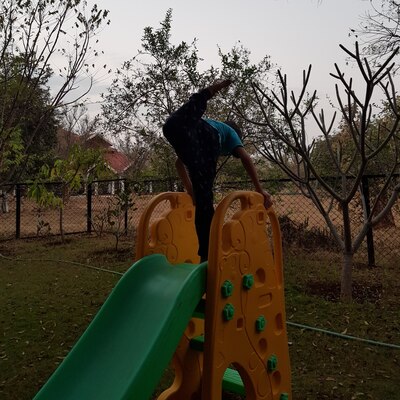
It was break time for the LKG kids, and everyone was taking turns on the slide, their laughter ringing out in the noon sun, their small bodies moving with a confidence I could not understand and yet deeply wanted to share.
Trriinnnngggg!
Break time over. All the kids trooped back into the classroom. I got up too, relieved and disappointed in equal measure, ready to return to the safety of my seat.
“Gayatri, wait. Come here.”
Mrs Lamba’s soft voice stopped me.
She took my hand—not firmly, not insistently, but gently, as though she already knew that too much pressure would make me retreat—and led me back to the slide.
“Just climb one step, that’s all. Try.”
I looked up at the steps. They seemed impossibly tall, far taller than they probably were, looming over me like something to be conquered rather than climbed.
But Mrs Lamba held my hand.
And she was the best teacher in the whole world.
And, perhaps most importantly, no one else was there to watch me struggle.
I clutched her hand tightly with my right. My left hand gripped the railing as though letting go would send me tumbling into something far worse than a fall.
I climbed a step.
Paused.
Another.
Paused again, longer this time.
And then another.
I don’t know how I reached the top.
But I did.
I remember sitting there, clutching Mrs Lamba, my small body rigid with fear and something else—anticipation, perhaps, or the faint stirring of courage that only comes when someone else believes you can do what you are not yet sure you can.
I remember her saree—plain chiffon, not quite red and not quite pink, my favourite colour even then.
I remember her voice.
But strangely, I do not remember her face.
“I’m holding you. Come on, slowly now…”
My heart was thundering in my throat, my mouth dry, a thin trickle of sweat running down my back in the heat, and I looked down at the slide—shiny, steep, terrifying, and yet… inviting.
And then I let go.
And slid down.
In that moment, something shifted.
The fear did not vanish.
But it made space.
For exhilaration.
For joy.
For the quiet pride of having done something I did not think I could.
To this day, I remember that feeling.
Mrs Lamba smiled—a wide, warm smile—and pulled me into a hug.
“Ma’am, once more, please?”
That once more became many times more, as I climbed and slid and laughed, my fear dissolving not through force, but through patience, presence, and trust.
My classmates gathered at the window and cheered me on, and for the first time, I was not standing apart from them, watching.
I was part of it.
I am neurotypical.
I am verbal.
And yet, at that moment, I could not express what I felt—the fear that held me back, and the longing that pulled me forward.
But my teacher saw it.
She did not dismiss it.
She did not override it.
She did not leave me to it either.
She met me where I was.
And walked with me, one step at a time.
Today, we have a word for this.
Inclusion.
And yet, when we speak of inclusion for neurodivergent children today, I often find myself asking—what do we really mean by it?
Who defines it?
And more importantly, who experiences it?
Is inclusion simply placing a child in a mainstream classroom and expecting them to adapt, to cope, to “fit in,” even when every fibre of their being is telling them that the environment is overwhelming, confusing, or distressing?
Is it when a child sits quietly next to others, doing their own thing, tolerated but not truly seen, present but not really included?
Or is inclusion something far more nuanced, far more human?
Is it the ability to recognise fear, discomfort, and need, even when they are not expressed in words, and to respond to them with sensitivity rather than impatience?
Is it about gently guiding a child forward while also making space for who they are, rather than who we expect them to be?
Is it about mutual accommodation—where the group adjusts, even slightly, just as the individual is encouraged to stretch, to grow, to engage?
Because inclusion, at its heart, is not about sameness.
It is about belonging.
It is about creating spaces where difference does not isolate, but is held, understood, and woven into the fabric of the group.
What Mrs Lamba did that day was not extraordinary.
It was simple.
And yet, it was everything.
She saw a child who was afraid.
She recognised a child who wanted to try.
And she chose patience over pressure, support over instruction, presence over expectation.
That is inclusion.
Not a policy.
Not a checkbox.
But a way of seeing.
A way of responding.
A way of being.
And perhaps, if we can bring even a fraction of that into our homes, our schools, our communities, we will begin to move closer to what inclusion is meant to be.
Not just for neurodivergent children.
But for all of us.