
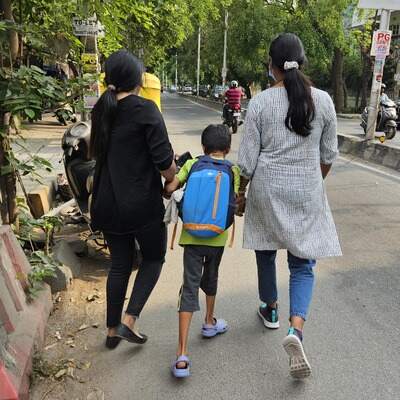
“Krishna goes to therapy? What about school?” someone asked me.
“He can’t handle school as of now,” I replied.
“Oh, how sad. You must try, you know. Don’t say he can’t handle it. Put him back in school and see. He’s missing so much!”
“Thank you,” I smiled.
The someone meant well—convinced that I was causing Krishna to miss out on an important stage of life: school.
The fact is, Krishna cannot handle school right now.
I’m not even talking about academics.
I’m talking about the constant assault on his senses—being in a room full of people: teachers, children, helpers—the sounds, the lights, everything.
It is difficult to explain sensory overload to every person I meet who has an opinion on how to bring him up.
It is difficult to explain why Krishna, who happily went to school at five, cannot handle it today.
It used to bother me a lot.
I felt guilty, defensive, and anxious.
And yes—envious of other parents who seemed to have it easier.
I doubted myself.
I wondered if I was doing the right thing.
The solution, for me, was simple: a facts check.
I asked myself how Krishna would feel.
Will he suffer in school?
Yes.
Will he adjust after a month or so?
No.
Will he learn anything at all?
No.
How would he, if he were curled up into a ball all the time, unable to regulate himself?
Today, I understand that my frames of reference and values are not necessarily Krishna’s.
He does not enjoy long interactions with children his age.
Education is important—but the ability to handle the classroom environment is a prerequisite.
So how do I explain this to all the someones?
Simple.
I don’t.
I accept their concern and thank them.
I smile at those who are simply being nosy—or even unkind—and thank them too.
Because where can such people go, in the face of a smile and a thank you?
And that is often the best response to something you cannot—or do not wish to—explain.
Say thank you.
With a smile.
Or say, “You’re right.”
Or, “I understand.”
And smile.
That’s it.
No explanations.
No justifications.
And watch them falter.
My little fellow is not so little anymore—he’s growing up.
He had a more wonderful eleventh birthday celebration at his therapy centre than he would have had in any school: no work, all play, and cake—for three glorious hours.
“What! He won’t learn anything by only playing,” you may think.
Oh, he did.
He learnt that his birthday is a special day that comes once a year.
He learnt that he has the freedom to choose what he does on that day.
He learnt that new clothes and balloons are his family’s way of celebrating him.
All of which are huge learnings—rather, re-learnings—for Krishna.
Thank you, Early Autism Ventures, for making this happen.