
It was a dark and stormy night! Krishna was about two years old. He was thrilled by the storm and his father was holding him in front of the bedroom window. The trees danced madly in the wind. Thunder crashed, lightning lit the night sky an eerie green. Rain lashed the garden outside; the gods were perhaps emptying down buckets, cleaning their overhead tank.
Krishna was fixated on a corner of the wildly flying curtains. My husband squinted into the shadows: it was a little snake that had wriggled in through the mesh window.
A few years later, a bronzeback darted in through just-opened doors. A couple of years later, yet another reptile, whose species name I don’t know, slithered in and made itself at home.
Last night, I entered the bedroom and froze, sighting a long, speckled form on the floor. A paralysing moment later, I sighed and relaxed. It was Krishna’s drawstring. He had yanked it off his pajamas and flung it on the floor. But that moment when I thought it was a snake, my blood froze—the danger my mind ascribed to an innocent piece of rope.
Rajju sarpaḥ.
Rope snake.
The ancient philosophers used this simple image to illustrate one of the most profound habits of the human mind: in mistaking a rope for a snake I projected my fears and assumptions onto reality. Though, of course, the sages debated whether either the rope or the snake was ultimately real. (I could, at this point, digress into Advaita and Schrödinger’s thought experiments, but I won’t.)
The insidious part of this assumption-fear-reality-relief cycle is that the assumptions and fears are rarely invented out of thin air. They are built upon memory. Experience. Real experience. Many times, experiences repeated often enough that they are branded into the nervous system. We had found snakes in our bedroom before. More than once. My nervous system wasn’t being dramatic. It was doing precisely what millions of years of evolution had trained it to do. It saw a familiar pattern and reached the conclusion required for safety (Beware! Snake!) before my conscious mind had caught up.
That is how fear works.
It borrows from yesterday to prepare us for tomorrow. Most of the time, that serves us extraordinarily well. But then, occasionally, it mistakes a drawstring for a snake.
Letting go of those assumptions and fears, every single time, and recognizing the facts—seeing the rope for what it is—is acceptance.
Acceptance is neither convincing ourselves that every snake is really a rope nor in pretending that danger doesn’t exist or fear is unnecessary.
Acceptance is in pausing just long enough to let reality finish revealing itself before the mind rushes in to complete the story.
It begins with seeing.
Not seeing through fear. Not seeing through hope. Not seeing through grief or guilt or expectation.
Just… seeing.
Reality, before the stories.
When Krishna was diagnosed with autism, nothing fundamentally different happened. The diagnosis itself was astonishingly simple. My son is autistic. Everything else arrived afterwards:
Why?
How? How autistic is autistic? Mild? Medium? Severe?
Regression? What is it? How? Why?
How did he lose his toileting skills? Speech? Writing?
Will he have friends?
Will he be happy?
Will he live independently?
What will happen to him after I’m gone?
My mind was doing exactly what it had done with the drawstring. It wasn’t content with reality as it stood. (Reality also didn’t oblige by standing still; it kept changing.)
My mind wanted to finish the picture. It wanted certainty where none yet existed. It wanted a future it could predict, control and prepare for.
None of that was unique to me. It is what human minds do.
We are uncomfortable with uncertainty and stories give uncertainty an ending. Facts are rarely enough. We want explanations. Causes. Reasons. Guarantees.
And when life refuses to provide them, we begin writing them ourselves.
The diagnosis became tangled with predictions. Predictions became tangled with fears. Fears became tangled with identity. Before long, it became almost impossible to separate what had actually happened from everything I had layered on top of it. (Add in my increasingly fickle memory – a recipe for chaos.)
Perhaps this is why acceptance is such a misunderstood word.
We imagine acceptance means liking something. Or approving of it. Or surrendering to it. Or refusing to change anything.
No wonder conversations about acceptance become so emotionally charged because acceptance isn’t a small, static thing. It has as many layers and nuances as humans themselves do.
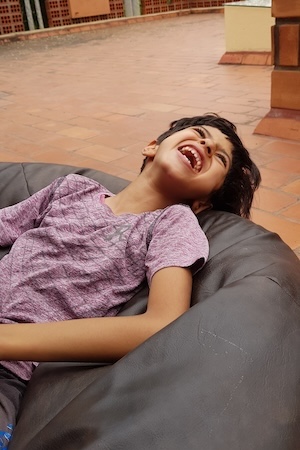
I don’t just accept Krishna – I celebrate him. I celebrate his mischievousness, capacity for joy, unique demonstration of love; his alertness, his playfulness, his capacity to extract the very last drop from every second. Autism or not, this is the essence of him.
I accept that he is autistic (a plain fact with no attached morality). I recognize the challenges he faces and refuse to passively accept them – I will do everything I can and more to improve his quality of life.
I accept that I am an autism parent of a child with high support needs and complex medical issues, which means I accept chronic exhaustion and vigilance, the need to set difficult boundaries, and recognizing that my yeses are few and nos, many. I recognize the danger of erosion of self, and refuse to be passive about it.
See?
Acceptance itself has layers.
The first layer is simply the acceptance of reality.
My child is autistic.
I am an autism parent.
Today was difficult.
These are facts. They do not require my permission or approval. They do not become more or less true depending on how I feel about them.
Reality asks for recognition, not agreement or permission.
The second layer is the acceptance of my emotional reality.
I am frightened.
I am grieving.
I am angry.
I am exhausted.
I am hopeful.
These, too, are facts. Not permanent facts, perhaps, nor defining facts. But real nonetheless.
So much energy is spent arguing with or denying our own emotions, as though acknowledging them somehow grants them more power. Is an unnamed fear more or less insidious than a named, acknowledged one? Does denying grief prevent or sidestep loss?
Emotions are not failures of character. They are information. They tell us something about the way we are experiencing the world. They deserve to be acknowledged, especially the difficult ones, without letting them take charge of our lives. Named and acknowledged emotions can show us how to navigate life instead of blundering through it.
The third layer of acceptance is seeing the reasons for those emotions.
Why these emotions?
What story am I telling myself?
What assumptions have I made?
What have I concluded with or without evidence?
This is where the rope pulls on the skin of the snake.
No—that isn’t quite right.
This is where I clothe the rope in the snake’s skin.
Not deliberately. Or foolishly.
Humanly.
My mind completes the unfinished picture using memories, expectations, cultural narratives, conversations with well-meaning relatives, frightening articles on the internet, comparisons with other children, and every fear I have ever carried as a parent.
The story begins to masquerade as reality. Reality may be less frightening than the story. Or more. We never know, because the story has clouded our seeing of reality.
The final layer is the acceptance of the conditions in which life unfolds.
What resources do I actually have?
What support surrounds my family?
What are Krishna’s strengths?
What are his challenges?
What medical issues are present?
What educational opportunities exist?
What financial realities shape our choices?
What can I influence?
What lies completely outside my control?
These are the layers of acceptance.
Seeing each of these realities clearly, without confusing one for another.
The fact is not the feeling it inspires.
The feeling is not the story about it that we tell.
The story is not the circumstance.
And none of them, by themselves, determine what comes next.
So why do we clothe the rope in the snake’s skin?
Our danger sense is programmed to keep us alive. Imagine prehistoric man emerging cautiously from his cave each morning. Around him were predators stronger, faster and far better equipped than he was. If something rustled in the bushes, it was far safer to assume it was a tiger than the wind. If he mistook the wind for a tiger, he lost a little time and perhaps looked rather silly. If he mistook a tiger for the wind, he became breakfast.
Better safe than sorry.
Thousands upon thousands of generations survived because they anticipated danger before they confirmed it. We are their descendants.
The trouble is that our danger sense treats uncertainty itself as danger. Presented with an incomplete picture, it begins filling in the gaps.
In our world as autism parents, danger wears the face of uncertainty as well as suffering and safety looks like certainty (any certainty) and comfort.
We fear suffering.
We seek comfort.
There is nothing wrong with either instinct. It is deeply human. But fear has a way of clothing reality in stories before reality has had a chance to fully reveal itself.
Rajju sarpaḥ.
If life is going well for the moment, we look over our shoulders waiting for something terrible to happen, suspicious that such ease cannot possibly last. If life becomes difficult, we search frantically for reasons. We ask what we did to deserve it. We search for lessons before we have even understood the experience itself. We assign morality to circumstances as though the universe operates an invisible accounting system that rewards virtue with comfort and punishes failure with suffering.
Since none of us can prove the morality of suffering or comfort, why not simply take them at face value?
Suffering is neither sacred nor evil.
Comfort is neither virtue nor decadence.
They simply are.
Like rain. Like drought. Like winter. Like summer.
We are the ones who insist on asking what they mean before we have even understood what they are. Most likely because suffering hurts. When we see others enjoying relative comfort, we covet it. That is natural. Entirely human.
We watch our autistic children struggle where neurotypical children seem to move through life with ease. We navigate appointments, therapies, schools, gastrointestinal issues, sleepless nights, meltdowns, uncertainty and the thousand invisible adjustments that slowly reshape family life. We grieve for dreams that no longer fit. We fear futures we cannot see.
We ask:
Why my child?
Why me?
If we do not create stories to answer those questions ourselves, the world is often more than willing to provide them. Someone suggests karma. Someone whispers vaccines. Someone blames parenting. Someone insists autism is a gift. Someone else calls it a tragedy. Before long, we are carrying not only our own fears, but everyone else’s narratives as well.
The stories feed the suffering.
The suffering feeds the stories.
Round and round they go.
And yet, if we stop for a moment, if we allow reality to stand on its own before demanding that it justify itself with one story or another, we can move forward without bearing the burden of living that story.
Why not view suffering as neither punishment nor blessing?
Why not view comfort as neither reward nor entitlement?
Let me continue in this vein.
Life is a crucible and we are the metal. Suffering and comfort are simply two of the many fires within that crucible. Let us say that suffering blazes hot while comfort burns cold. Neither has a moral preference. Neither asks whether we deserve it. They simply create the conditions under which we are shaped.
A hotter fire can strengthen metal, but it can also melt it. A cooler fire can preserve it, but left long enough, it can leave it brittle. So it is with us. Suffering can deepen compassion, wisdom and resilience. It can just as easily erode hope, harden the heart or consume a person entirely. Comfort can offer rest, healing and the space to grow. It can just as easily breed complacency, entitlement or a life never fully examined.
Neither suffering nor comfort determines who we become.
Life is not that simple.
The fires of the crucible shape us. So do our circumstances. So do the people around us.
But then, we are not inanimate metal in a crucible.
We are human beings with the capacity for agency. Not agency over the fire itself, but over how we train ourselves to meet it. Whether our first instinctive reaction slowly gives way to a considered response. Whether we become a little more aware each time the fire burns.
Recognising suffering and comfort as fires that shape us is acceptance.
Learning how to meet those fires is agency.
Without turning the rajju into the sarpaḥ.
Only when I can see reality for what it is—my child’s reality, my emotional reality, the stories my mind is constructing, and the circumstances in which all of this unfolds—can I begin asking the most important question:
What is mine to do?
Krishna will still need to be chased around to get his teeth brushed. He’ll still need to be fed, and he’ll giggle and run away waving his food-y hands while I chase after him to wash them. He won’t give a hoot whether I solved the philosophical problem of suffering and agency.
He’ll simply need me.
And so, my agency does not lie in deciding whether my child is autistic.
It does not lie in choosing whether suffering visits my family.
It does not lie in controlling outcomes that belong to biology, chance, society or time.
My agency lies in training myself.
In becoming more emotionally regulated than I was yesterday.
In learning.
In observing more carefully.
In apologising when I fail.
In advocating more effectively.
In loving more generously.
In responding rather than merely reacting.
Circumstances shape the environment in which my agency is exercised; they do not replace it. Perhaps this is why acceptance is so often mistaken for passivity, because acceptance without agency becomes resignation.
And agency without acceptance becomes fantasy.
One refuses to move.
The other refuses to see.
Neither serves our children particularly well.
Acceptance is not the opposite of action; it is the foundation upon which meaningful action becomes possible.
The drawstring didn’t become safer when I saw that it wasn’t a snake. There was no change in its intrinsic nature; only my realization of it. Nor would a real snake become more dangerous when I recognized it wasn’t just a rope. The snake’s intrinsic nature doesn’t change, either. (And, I won’t digress into whether the snake was venomous!)
Reality remains what it is.
When the drawstring became visible to me for what it had always been, I could respond appropriately. And so too, had I mistaken a snake for a rope.
Our autistic children deserve that we see reality for what it is.
Not the clarity of ideology.
Not the clarity of fear.
The clarity of reality.
From there, we help where help is needed.
We support where support is needed.
We celebrate where celebration is deserved.
We grieve when grief comes.
We pursue treatments for suffering.
We nurture strengths.
We advocate fiercely.
We rest when we must.
We begin, always, with what is.
The snakes will probably continue visiting our home from time to time. If they do, I hope my nervous system still startles before my intellect catches up. It has kept my family safe far more often than it has embarrassed me.
But perhaps, before fear becomes fact, I can pause.
Long enough to look again.
Long enough to let reality finish revealing itself.
Long enough to ask the oldest question of all.
Rajju… or sarpaḥ?