After Krishna was diagnosed as autistic seven years ago, his school asked him to leave.
It was a CBSE school.
They were supposed to provide a shadow teacher to facilitate learning for children with special needs.
A doctor from NIMHANS had given the school a letter clearly stating that Krishna could attend regular school at the time, but needed a shadow teacher.
The school still asked us to take him out.
I vaguely remember being devastated—crying, feeling lost.
My husband tells me we both felt as if it were the end of the world.
Today, I feel immense gratitude for the school’s behaviour.
Yes, gratitude.
If they had been kinder, I would have continued taking Krishna there—despite the trauma he was experiencing.
That trauma led to severe separation anxiety.
For six months after the incident, he clung to his father or me, almost all the time.
And still, I would have continued taking him.
Because at the time, I didn’t know any better.
I didn’t realise that I wanted him to go to school for my own reasons.
Because I believed that was what children were supposed to do—to learn, to prepare for the world.
But for Krishna, it would have been the opposite.
It would have meant daily stress.
Daily trauma.
He had just begun to show signs of anxiety and sensory overload.
I didn’t know any of this then.
The school certainly didn’t.
By asking us to leave, the Universe—or fate, or whatever you choose to call it—worked through the school to do us a favour.
A very big one.
At that time, I remember frantically searching for another school.
My husband, who has a far better memory than I do, tells me that Krishna would recite whatever he knew—rhymes, the alphabet, numbers—anything, just to cheer me up.
(That is a story for another day: don’t hide all your emotions from your child.)
Today, I can tell you this:
When you seek inclusion, it must be from your child’s perspective—not your own.
Krishna wanted new experiences.
He wanted to socialise.
He wanted to learn.
It was my responsibility to create a space where he could do all of this safely and happily—without being traumatised.
In hindsight, I see that events that seem disastrous can carry hidden benefits.
Sometimes we recognise them later.
Sometimes we never do.
So it is okay to believe that what happens, happens for a reason—even when we cannot see it.
As we say in Tamil: nadappathellam nallathukke.
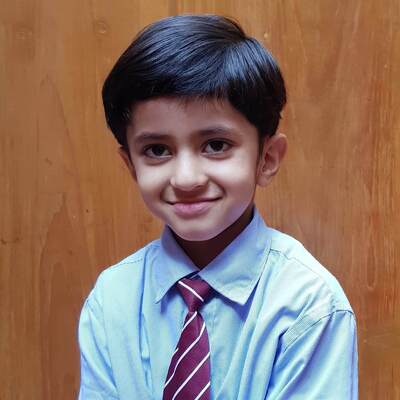
PS: That’s my little fellow in the picture, seven years ago—bright-eyed, ready for school, and impatient to see who would drive him.