
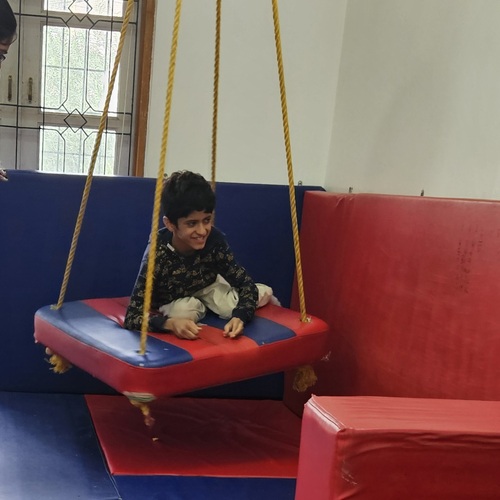
When Krishna began speech therapy, he had excellent expressive language and poor communication.
At the end of one year, he was nonverbal.
And I love telling this to people and watching their expressions: Is she for real? OMG, is speech therapy so dangerous? Should I send my child to speech therapy? Perhaps the therapy centre she took Krishna to was bad?
I took Krishna to one of the best speech therapy centres in Bangalore. So jokes apart, the lesson I learnt was that different autism trajectories respond differently to interventions.
Interventions are often trying to solve entirely different problems.
This sounds obvious when stated plainly. Yet autism parents are often thrown into a chaotic ecosystem where every therapy is marketed with near-religious certainty. Speech therapy. ABA. OT. Floortime. Communication therapy. Biomedical interventions. Functional medicine. Sensory integration. GFCF. Movement therapy. Social skills training. Horse therapy. Water therapy. Music therapy. Stem cells. Hyperbaric oxygen. Probiotics. Supplements. Detoxes.
And somewhere inside all this chaos is a harried parent desperately wondering, will this help my child?
Just as autism is diagnosed from its external expression in the child while there are different underlying biological pathways, therapies too try to address both these aspects: behavioral and physiological approaches.
The first attempts to work with behavior, communication, regulation, learning, participation, and adaptive functioning.
The second attempts to work with physiology itself: sleep, GI function, inflammation, metabolism, seizures, nutrition, immune pathways, sensory burden.
Of course, the two constantly overlap because autistic children inconveniently insist on being whole human beings instead of neatly separable nervous systems.
And somewhere in between sits an endless ecosystem of hybrids, overlaps, theories, experiments, and hopeful improvisations.
Behavioral / Developmental Approaches
- ABA
- speech therapy
- OT
- communication therapy
- AAC
- PECS
- Floortime
- movement-based therapies
- sensory integration
- RPM/S2C
- social skills approaches
Physiological / Medical / Biomedical Approaches
- GFCF diet
- seizure treatment
- sleep interventions
- GI treatment
- supplements
- probiotics
- microbiome-focused therapies
- functional medicine
- biomedical approaches
- anti-inflammatory approaches
- metabolic and mitochondrial supports
- chelation
- hyperbaric oxygen
- endless combinations and hybrids of all of the above
Some are strongly evidence-based.
Some remain controversial.
Some appear promising for specific subgroups.
Some drift steadily toward pseudoscience.
And parents standing in the middle of all this are somehow expected to make calm, rational decisions while terrified for their children. And most often the expectations are what parents place on themselves.
The difficulty is that “help” itself is not one thing.
For some children, the urgent need is communication. For others, pain reduction. Or emotional regulation. Adaptive skills. Sleep. GI stability. Or simply making daily existence more tolerable.
And autism itself is a whole spectrum of conditions, anyway. So why do we expect one intervention framework to fit every child equally?
I’m now going to meander through most of the interventions that Krishna went through because each of these shaped our understanding of what was happening with him and what worked for him.
That year with speech therapy was actually educative.
I am certainly not saying speech therapy caused Krishna’s regression. I am saying it did not alter the trajectory that Krishna’s autism follows. And we had no way of knowing that at the time. To us, it looked like we were doing the best we could by taking him to the best speech therapy centre, as recommended by his doctors.
And so parents carry a burden they rarely admit aloud: sometimes a child’s underlying neurological trajectory is stronger than the intervention itself. (Read: no matter the early intervention, your child doesn’t “improve.”)
That is not parental failure.
That is biology.
The only measurable “gain” from speech therapy was that Krishna enjoyed the sessions. He liked the therapist. He was engaged. Happy.
And what I could have done was assess after three months and then stop speech therapy, and change to something else that also kept Krishna engaged and happy, but also yielded some results. Instead, I waited for the entire year…
We moved on to communication therapy, because at the end of the day that is what matters: Krishna should be able to consistently communicate his basic needs in any way that the caregiver or therapist can understand.
So this is one area where I remain deliberately patient. Communication itself may emerge through pathways we still poorly understand, especially in profoundly autistic or regressive children. So I continue experimenting. Different modalities. Different approaches. Different access routes.
That includes RPM and related approaches. And here, my thoughts there are complicated.
If a child genuinely enjoys the activity, feels engaged, regulated, focused, emotionally connected, cognitively stimulated — that itself may hold value. Children deserve enriching experiences regardless of whether measurable communication suddenly emerges from them.
But engagement and meaningful independent communication are not automatically the same thing.
That is where the controversy begins.
Can the child initiate independently?
Can they communicate novel information autonomously?
Can communication generalize across contexts?
Can the nervous system reliably express intent without subtle external cueing?
In my opinion: no.
I do not see convincing evidence yet that RPM reliably produces meaningful independent communication.
Activity: potentially wonderful (though not for Krishna; he gets irritated.)
Communication: still scientifically dubious.
The same thing happened with what was called “movement therapy.”
Which, if we are being completely honest, was largely teaching Krishna dance.
No dramatic gains emerged from it. No sudden language. No miraculous developmental leap.
But Krishna liked the therapist. He engaged happily. There was joy.
I found this hilarious at first. And on difficult days, when therapy bills piled up endlessly and I was in an agony of irritation, I felt the entire autism world had discovered increasingly creative ways to extract money from already exhausted parents.
Wheel therapy (cycling, skating).
Water therapy (swimming).
Movement therapy (dance).
And somewhere in the middle of all this, the terminology stopped sounding ridiculous. Teaching dance to neurotypical children usually assumes a shared baseline of sensory processing, motor imitation, communication, regulation, participation, and body awareness. Or, to speak English, neurotypical children can mostly be taught in the same way.
With autistic children, those foundations themselves may need careful support. Personalized attention. Compassion. The ability to constantly adapt teaching methods on the fly depending on what the nervous system in front of you can tolerate in that exact moment.
So the same activity stops being merely extracurricular; it becomes access. And personalization means the therapist or instructor has to focus their attention and energy on one child, not many. Voila, expensive.
The gluten-free, casein-free diet made the single biggest difference for Krishna.
The changes were physiological. Less GI distress. Better regulation. Less overall bodily misery. (Read: much better sleep!!!)
ABA helped in a very different way.
The internet often speaks about ABA as though it is either salvation or abuse incarnate. My own view is more pragmatic. Therapies are tools, and tools are only as good or bad as the philosophy guiding them and the people wielding them.
The first ABA centre I took Krishna to was determined to use a very basic reward system: toys. More toys. Still more toys.
Krishna does not play with toys.
The reward itself exhausted and irritated him.
Not allowing him to lie down for a while in a clean, quiet space every few minutes became even more stressful because physically, he simply could not keep up with the demands being placed on him.
The second centre approached him very differently.
They worked with him to identify reinforcements that changed constantly depending on Krishna’s mood, regulation, and energy levels. Social reinforcement. Music. Dance. Time outside in the garden. Sensory breaks. Flexibility.
And slowly, Krishna responded. Early Autism Ventures has worked beautifully for him. (And no, this is not a paid post or an advertisement for EAV!)
If I had rejected ABA entirely because of that first experience, Krishna would likely have missed out on learning how to tolerate some of the unavoidable stresses life throws at him.
Haircuts, for example.
This may sound laughably ordinary to outsiders.
It is not.
Haircuts once meant screaming. Crying. Running away. Hitting. And because of the meltdowns only I could cut his hair, over the entire week. Both of us dreaded the entire experience long before it even began. But now, thanks to ABA and EAV, Krishna can bear going to a salon and allowing a hairdresser to cut his hair.
Krishna still dislikes haircuts intensely. He probably always will.
But now he tolerates them.
He knows the haircut will end.
And why not simply let him grow out his hair?
Because he cannot tolerate the maintenance either. Washing. Combing. Grooming. Braiding. The sensory burden of long hair itself becomes another source of suffering.
One is monthly torture and the other, daily.
These are the realities autism parenting often consists of. Endless negotiations with another human being’s nervous system.
OT helped Krishna with sensory regulation, participation, motor planning, and skill acquisition. Right now Krishna is learning cycling. Slowly. Unevenly. Under protest on some days and with delight on others.
And he usually enjoys OT.
This matters too.
My own yardsticks for interventions are fairly simple now.
I am open to almost anything as long as a few basic conditions are met:
Will this hurt or stress Krishna unnecessarily?
Will he feel safe?
Are the people working with him empathetic, observant, curious, and genuinely interested in understanding him as a person instead of forcing him into a rigid protocol?
Can I remain beside him inside the therapy room initially, until he settles and feels secure?
And after that:
Is Krishna engaged?
Is he calmer?
Happier?
More comfortable inside his own body?
Are there observable benefits?
Therapies are just tools. They aren’t moral identities or judgements.
And tools should serve the child standing in front of us, not ideology.
This becomes especially difficult because autism parenting exists inside a constant atmosphere of panic.
The “window is closing.”
“You must intervene early.”
“Every month matters.”
“Act now before it is too late.”
Some of this urgency comes from real science. Early support absolutely can matter.
But the emotional atmosphere surrounding autism intervention can become relentless. Parents are pushed toward marathon therapy schedules, endless appointments, terrifying urgency, miracle promises, and the gnawing fear that one wrong decision may permanently alter their child’s future for the worse.
And for parents of regressive children, that panic acquires another layer entirely.
Because you are not merely waiting for development. You are watching skills disappear. So parents try all manner of interventions, whether or not backed by science or evidence. In a way this makes sense because science has a lot of catching up to do. So the onus is on us, the parents. to sift through the chaos and decide what may work for our children.
This is where my biomedicine and functional medicine stories come in. I tried these at various points in Krishna’s life when his gut health hit the nadir: he was struggling with severe yeast infection, throwing up whatever he ate, losing weight…
The dietary changes introduced by biomedicine and functional medicine helped a little.
The violent use of antibiotics put me off; I refused that part.
Some supplements helped. Others were too strong-tasting for Krishna, and so I threw them out, wasting huge chunks of money.
And through this, Krishna was slightly more comfortable but in danger of malnutrition, especially because he couldn’t tolerate most of the supplements.
Then, chelation was suggested as the next logical step for Krishna.
That was where I stopped.
Every family eventually reaches its own threshold between possibility and risk. Hope and harm. Evidence and speculation.
This is perhaps the hardest part of autism parenting.
You are constantly making decisions inside uncertainty.
And underneath all these intervention wars — ABA versus anti-ABA, biomedical versus anti-biomedical, diet versus anti-diet, neurodiversity versus pathology — I increasingly suspect many people are discussing profoundly different children while using the same diagnostic label.
The parent trying to help a child tolerate haircuts, communicate discomfort, sleep through the night, stop self-injury, digest food properly, and avoid malnutrition inhabits a very different reality from the parent primarily navigating workplace accommodations or social communication differences.
Neither is wrong.
But they are not always discussing the same lived experience either. And perhaps that is why autism intervention conversations become so emotionally explosive. Because autism itself may involve many different trajectories, burdens, and biological pathways hidden beneath one umbrella diagnosis.
I no longer believe in miracle therapies.
I no longer believe every intervention failure reflects parental inadequacy either.
What I believe now is simpler.
Observe the child.
Reduce suffering where possible.
Build skills where possible.
Protect dignity always.
Remember to put away the therapy lens for a while and just be with your child.
Play.
Sit together.
Waste time.
And never let fear, panic, social pressure, ideology, or wishful thinking become more important than the reality of the human being standing in front of you.