
Part 2: SPI
What does it mean to live with autism?
Let me share a little of my experience the past 10 years as the mother of an autistic child.
Autism and sensory processing issues (SPI)
Autism majorly walks hand in hand with sensory processing issues.
We experience the world through sight, smell, taste, sound, and touch, right? Our 5 senses. We develop a sense of balance and awareness of our body.
A person with autism may find each one of these overwhelming, either because of overstimulation or understimulation. For my son Krishna, it is overstimulation.
Take an ordinary setting in a home. Sudden light or a visual from a phone/laptop/TV may startle. Smells of cooking or cleaning products may overwhelm. Sounds of the phone ringing or the blender running may jar. Certain tastes or mingling of tastes may repel. Textures like a rough cloth or sticky playdough may repel or fascinate. There may be a sudden desire to climb to the highest point available (like parapet walls in the terrace) or the fear to raise his foot 6 inches to climb a step.
The impact of SPI on the quality of life
Just imagine what this means in daily life activities through the day:
Getting him to brush his teeth is a challenge.
Getting him to poop and pee is a challenge.
Getting him to take a bath is a challenge.
Getting him to brush his hair is a challenge.
Getting him to dress, on somedays, is a challenge.
Getting him to eat and drink is a challenge.
Getting him to step out of the house is a challenge.
And the list goes on…
Now tweak this to Krishna’s perspective:
Brushing my teeth is painfully jarring.
Pooping and peeing are painfully jarring.
Water on my skin is painfully jarring.
The feel of a hand or water or an implement on my head is painfully jarring.
The feel of fabric on my skin is painfully jarring.
The texture and taste of this food and drink is painfully jarring.
The world outside is painfully jarring.
When every single activity of living is overwhelming, how can one reasonably expect that child or adult to conform to neurotypical behavior?
Managing SPI: Desensitization and Occupational Therapy
These challenges can be managed, to a certain extent, by desensitizing activities, a sensory diet, and occupational therapy.
Sans the jargon, these mean that you have the therapist design and plan activities through the day that expose the child to the sensory stimuli they find distressing, acclimate them to these stimuli, and teach them to cope.
And let me stress here: desensitization for these children doesn’t mean they suddenly begin to like brushing their hair or cutting their nails.
Not at all.
At best, desensitization teaches them to endure the discomfort because it is temporary and “must be done.”
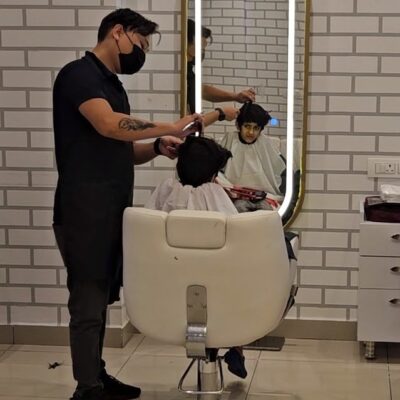
I took Krishna for a haircut a couple of days ago. He walked into the salon, clutching my hand, trying to climb me like a tree.
The salon manager and some of the stylists gave him a huge smile and a loud, cheery “Hi!!!” Krishna startled and tried to burrow into me. And then slowly, shyly, he peeped out and waved to the floor, his way of saying, “Hi!” He settled onto my lap and proceeded to get one of smartest haircuts in his life.
This is absolutely HUGE for Krishna.
Just a year ago, I wouldn’t have dreamed of taking him out for a haircut. I’d have done it myself at home, over 4 days, with a lot of screaming, self-hurting, and running away on Krishna’s part. I would have given up, and let him grow out his hair. But he found that uncomfortable, too. Because long hair needs washing, combing, detangling, and braiding on a daily basis, right? That is torture for Krishna on a daily basis.
For Krishna’s current maturity and understanding, I thank his therapists at Early Autism Ventures for the desensitizing that happened over all of 2024. I do know that ABA therapy is deemed “robotic” and is controversial. And yet, I’ll stand up and defend it any day as a tool that needs to be used appropriately. Using ABA to suppress stimming? A BIG NO. Using ABA to help your child with life skills? Of course. (I’ll talk about stimming in my next essay.)
For the absolutely pleasant surprise of finding empathetic people in a purely commercial establishment, I must thank Plum and Sugar, JP Nagar, Bangalore.
Krishna has learnt to manage at least one unpleasant task that must happen in his life on a regular basis: haircuts. But his journey doesn’t stop here. There still be miles to go…
I’ll share more next week. Till then, I hope this is what you’ll take away:
Sensory issues do not go way. The autistic individual learns to live with them. And this heightened sensitivity may also be the cause of exceptional genius and creativity in some.